Choosing the right water tank size in Phoenix starts with one simple question: What will you use the stored water for?
A homeowner planning emergency water storage has very different needs from someone collecting rainwater for landscaping, irrigation, or outdoor use. The size of your household, roof area, desired backup period, available space, and water-use goals can all affect the ideal tank capacity.
Our water tank size calculator Phoenix homeowners can use helps estimate storage needs in two ways: household water usage and rainwater harvesting.
Use the calculator first, then compare your estimated capacity with available water tank sizes to find a practical solution for your Phoenix property.
What Size Water Tank Do I Need in Phoenix?
The best water tank size depends on how you plan to use the water.
For household water storage, calculate your average daily water demand and multiply it by the number of days you want your tank to provide backup water.
For Phoenix rainwater harvesting, tank size is based primarily on:
- Roof catchment area
- Rainfall
- Collection efficiency
- Landscape or irrigation demand
- Available storage space
A smaller tank may work for supplemental outdoor watering, while a larger system may be more appropriate if you want to capture runoff from a large roof or store water between Phoenix rain events.
Use the calculator above to get a personalized starting point before choosing a tank.
Why Water Tank Sizing Is Different in Phoenix
Phoenix’s desert environment makes water storage planning especially important.
Rainfall is limited compared with many other parts of the country, and extended dry periods can occur between storms. When rain does arrive, a large amount of runoff may be produced within a relatively short period.
That combination makes tank sizing a balancing act.
A tank that is too small may fill quickly during a strong rain event, sending usable water through the overflow. A tank that is much larger than your realistic collection potential, however, may increase installation costs without providing much additional benefit.
Phoenix’s heat also affects water demand.
Landscaping, trees, gardens, and outdoor plants can require significantly more water during hot months. Homeowners planning to use harvested rainwater for irrigation should therefore consider not only how much water they can collect, but also how quickly that water may be used.
The goal is to match three factors:
Water supply + storage capacity + expected demand
That is why using a Phoenix-specific water tank sizing calculator is more useful than simply choosing a common tank size.
How the Phoenix Water Tank Size Calculator Works
The calculator provides two different sizing methods depending on your project.
Household Usage Tab
Choose the Household Usage option if you are sizing a tank for backup water, emergency storage, or general residential use.
Typical inputs include:
- Number of household members
- Estimated gallons used per person
- Desired number of storage days
- Additional water demand
The basic calculation is:
Daily water demand × storage days = recommended usable capacity
For example, if your household requires 150 gallons per day and you want four days of stored water:
150 × 4 = 600 gallons
That gives you a baseline storage requirement of approximately 600 gallons.
You may choose a slightly larger tank depending on your available space, desired reserve capacity, and intended uses.
It is also important to distinguish between normal household usage and emergency usage.
During an emergency, you may only need water for essential activities such as:
- Drinking
- Cooking
- Basic sanitation
- Limited washing
If you are planning for normal whole-house consumption, water demand can be considerably higher.
Use your actual water goals when entering information into the calculator.
Rainwater Harvesting Tab
Select the Rainwater Harvesting option if you want to estimate how much runoff can be collected from your roof.
Your potential collection volume depends on several factors.
Roof Catchment Area
The larger your roof, the more rainwater you can potentially capture.
As a general rule, one inch of rain falling on 1,000 square feet of roof can produce approximately 623 gallons of water before collection losses.
That means a large Phoenix roof can generate a substantial amount of runoff even from a relatively short rain event.
Rainfall Amount
Rainfall determines how much water is available for collection.
Phoenix homeowners should think in terms of individual rain events as well as annual collection potential. Because rainfall can be irregular, having enough storage available when rain arrives can improve the usefulness of a harvesting system.
Collection Efficiency
Not all water that lands on your roof reaches your tank.
Some water may be lost because of:
- First-flush diversion
- Gutter overflow
- Splash
- Evaporation
- Screen and filtration systems
- Plumbing configuration
The calculator accounts for collection efficiency to provide a more realistic storage estimate.
Phoenix Rainfall and Rainwater Storage
Rainwater harvesting in Phoenix works differently from harvesting in climates with frequent rainfall.
Instead of receiving steady rain throughout the year, Phoenix can experience long stretches of dry weather followed by seasonal storms.
For additional information about water conservation and local water planning, homeowners can refer to the City of Phoenix Water Services Department. The department provides information about water conservation, drought management, and Phoenix’s long-term water supply planning.
This makes storage capacity particularly important.
Suppose your roof produces 900 gallons of usable runoff during a storm.
If your property only has a 250-gallon tank, you may capture less than one-third of the available water before the tank reaches capacity.
A 1,000-gallon tank could theoretically capture much more of that event, assuming the tank has enough empty capacity before the storm begins.
However, larger tanks are not automatically the right choice.
Consider:
- How large your roof is
- How much water your landscaping uses
- How quickly you empty the tank
- Available installation space
- Local property conditions
- Budget
- Tank location
A well-designed system should allow you to capture useful amounts of water without paying for storage capacity you are unlikely to use.
What Size Rainwater Tank Is Best for Phoenix?
There is no single ideal rainwater tank size for every Phoenix home.
Common residential capacities can range from relatively small rain barrels and compact tanks to tanks holding several thousand gallons.
The right size may depend on your goal.
Small-scale garden watering:
A smaller storage tank may provide enough water for garden beds, container plants, or supplemental landscaping.
Whole-yard irrigation support:
Larger tanks may be useful when you have a significant roof catchment area and want to reduce reliance on potable water for outdoor irrigation.
Large properties:
Homes with large roofs, multiple structures, extensive landscaping, or higher outdoor demand may benefit from multiple connected tanks or larger-capacity storage.
Before deciding, use the water tank size calculator Phoenix property owners can use to compare your potential supply with expected demand.
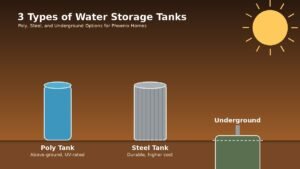
Choosing the Right Water Tank Type in Phoenix
Once you know approximately how many gallons you need, you can begin comparing tank configurations.
Vertical Water Tanks
Vertical tanks provide substantial storage while using a relatively compact footprint. They may be suitable for side yards, larger residential properties, commercial applications, and irrigation systems.
Slimline Water Tanks
Slimline tanks can be useful for Phoenix homes where space between the house and property line is limited.
They are often considered for residential rainwater harvesting and landscape watering applications.
Underground Water Tanks
Underground tanks can preserve usable yard space and reduce the visual impact of larger storage systems.
However, underground installations usually require excavation, site preparation, and careful planning.
Read more about underground water tanks before deciding whether this option fits your property.
Multiple Connected Tanks
You do not always need one large tank.
Several smaller tanks can sometimes be connected to provide the desired total capacity. This configuration may provide more flexibility when space, access, or property layout makes a single large tank difficult to install.
It can also make future system expansion easier.
Water Tank Installation Considerations in Phoenix
Tank capacity is only one part of planning a water storage system.
Before purchasing a tank, consider where it will be installed and how water will enter and leave the system.
Important considerations include:
- Tank dimensions
- Foundation or base requirements
- Property access
- Gutter and downspout locations
- Overflow routing
- Pump requirements
- Filtration
- Plumbing
- Sun exposure
- Maintenance access
Water is heavy, so the installation surface must be capable of supporting the tank when it is full.
If you are unsure which configuration will work on your property, speak with a local water storage professional before purchasing your tank.
Calculate Your Water Tank Size Before You Buy
Choosing the wrong tank size can cost more in the long run.
A tank that is too small may not provide enough usable water or may overflow frequently during rain events. A tank that is unnecessarily large may consume valuable space and increase the overall cost of your system.
Use our Phoenix water tank size calculator to estimate your storage needs first.
Then compare your results with tank sizes that fit your property, budget, and intended application.
Need Help Choosing a Water Tank in Phoenix?
Have your calculator result but are not sure which tank to choose?
Our team can help you compare water tank sizes, configurations, and storage options based on your Phoenix property and intended water use.
Frequently Asked Questions
How do I calculate what size water tank I need in Phoenix?
Estimate your daily water demand and multiply it by the number of days of storage you want. For rainwater harvesting, calculate potential roof runoff based on catchment area, rainfall, and collection efficiency. A water tank sizing calculator can simplify both methods.
What size water tank is best for a Phoenix home?
There is no single ideal size. The best tank depends on your household size, intended use, roof area, landscaping demand, installation space, and desired storage period.
Is a 500-gallon water tank enough?
A 500-gallon tank may be suitable for limited irrigation, garden watering, or short-term backup storage. Whether it is enough depends on how much water you expect to use between refills or rain events.
Is a 1,000-gallon water tank enough for a house?
A 1,000-gallon tank can provide useful residential storage, but whether it is sufficient depends on household consumption and intended use. For emergency-only needs, it may last considerably longer than when supplying normal household activities.
How much rainwater can I collect from my roof in Phoenix?
One inch of rainfall on approximately 1,000 square feet of roof can generate about 623 gallons before losses. Your actual collection will be lower because of first-flush diversion, gutter losses, evaporation, and collection efficiency.
Can rainwater harvesting work in Phoenix?
Yes. Although Phoenix has an arid climate, roof runoff from seasonal rain events can still provide useful water for landscaping, gardens, trees, and other non-potable applications.
Should I install one large tank or multiple smaller tanks?
Either option can work. Multiple connected tanks can offer more flexibility when space or access is limited, while a single large tank may simplify some installations.
Can I use stored rainwater for landscaping in Phoenix?
Rainwater is commonly stored for landscaping and irrigation. Your collection system, tank capacity, filtration needs, and distribution method should be designed around how you plan to use the stored water.