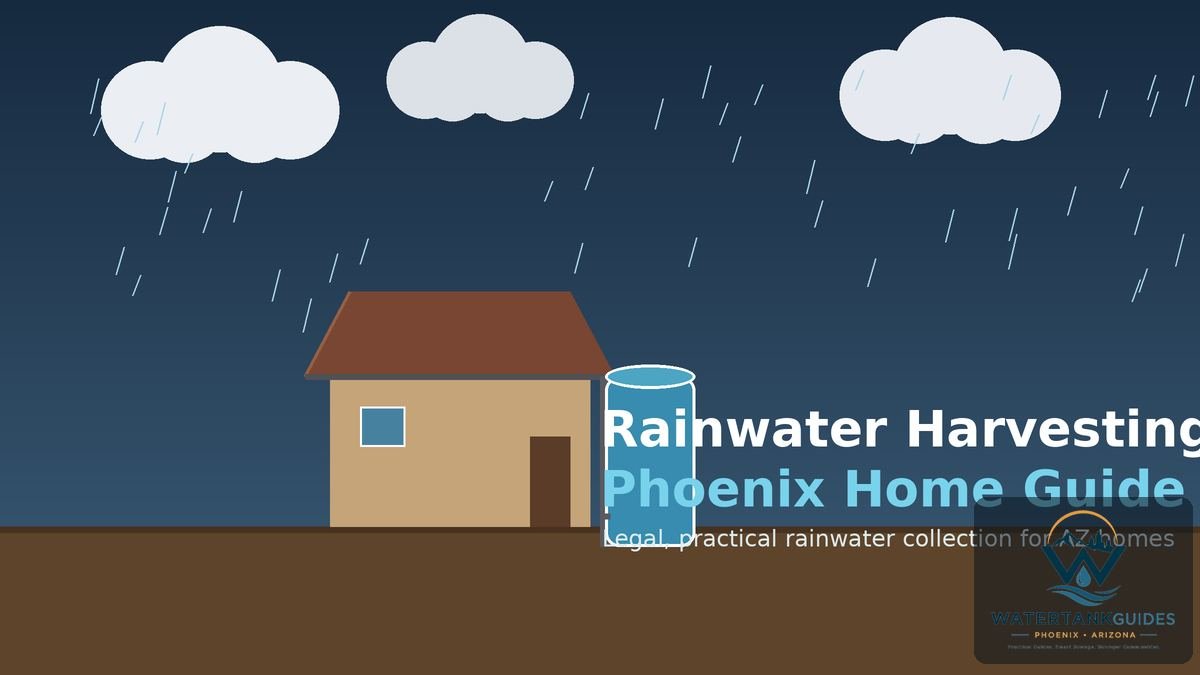
Rainwater harvesting can seem unusual in a desert city, but Phoenix homeowners may have more water available to capture than they realize. Even a relatively short storm can produce hundreds of gallons of runoff from an average residential roof.
In Arizona, collecting rainwater that falls on your property is legal. The University of Arizona Water Resources Research Center specifically states that Arizona property owners may collect rainwater falling on their property for future use, including storage in rain barrels and cisterns. The Arizona Department of Water Resources also promotes rainwater harvesting as a conservation strategy for residential landscapes.
For a basic rainwater harvesting Phoenix system, you generally need a catchment surface such as your roof, gutters and downspouts, debris screening, a first-flush system when appropriate, a storage tank or landscape basin, an overflow path, and a way to distribute the collected water.
Simple residential collection itself does not normally require a special state water-right permit. However, that does not mean every installation is automatically permit-free. Depending on the size, location, plumbing, grading, drainage changes, or work near public rights-of-way, City of Phoenix or Maricopa County permits and approvals may apply. Phoenix specifically advises that some green stormwater infrastructure projects require Planning & Development or Street Transportation approval.
For most homeowners, the easiest place to start is with landscape irrigation rather than trying to supply indoor drinking water.
Is Rainwater Harvesting Legal in Arizona?
Yes.
Arizona allows property owners to collect rainwater that falls on their property. The University of Arizona Water Resources Research Center describes rainwater harvesting as legal throughout the state and recognizes both rain barrels and larger cistern systems as collection methods.
Arizona also actively encourages water harvesting as a conservation practice.
The Arizona Department of Water Resources recommends rainwater harvesting for everything from small residential landscapes to larger properties. Its guidance describes simple systems using gutters, downspouts, and landscape contouring as well as more advanced systems using cisterns, pumps, and filters.
For a Phoenix homeowner, that means you can generally collect runoff from your roof and use it on your property.
Common uses include:
- Landscape irrigation
- Trees and shrubs
- Vegetable and flower gardens
- Native plants
- Dust control
- Supplemental outdoor water storage
Indoor or potable use requires much more consideration.
Rainwater collected from a roof can contain dust, bird droppings, insects, roofing residues, microorganisms, and other contaminants. The University of Arizona recommends appropriate filtration and disinfection when rainwater is intended for potable applications.
For most Phoenix homes, using harvested rainwater for landscaping is the simpler starting point.
Maricopa County-Specific Notes
If you live in Phoenix or elsewhere in Maricopa County, separate the question “Is harvesting rainwater legal?” from “Does my installation require a permit?”
Collecting rainwater is legal.
Installation requirements depend on the project.
City of Phoenix guidance notes that green stormwater infrastructure may require permits or approvals depending on its location and scale. This is especially important when a project changes drainage, involves significant grading, affects structures, modifies plumbing, or extends into a street or public right-of-way.
For properties in unincorporated Maricopa County, county permitting rules may apply to work involving plumbing, water tanks, grading, stormwater drainage, and related improvements. Properties inside incorporated cities normally follow the requirements of that city or town rather than the county’s general residential permitting process.
Before installing a large cistern, underground tank, major earthwork, or plumbed system, check the requirements for your specific address.
Passive vs. Active Rainwater Harvesting
There are two basic approaches to rainwater harvesting in Phoenix: passive and active harvesting.
Many properties benefit from using both.
Passive Systems: Basins, Berms, and Landscaping
Passive rainwater harvesting captures water directly in the landscape instead of storing it inside a tank.
Phoenix actively promotes green stormwater infrastructure and provides residents with guidance on stormwater harvesting basins, rain barrels, gutters, bioswales, and other ways to capture and reuse stormwater on residential properties. City of Phoenix Green Stormwater Infrastructure Guide
The goal is to slow runoff, spread it across useful areas, and allow it to soak into the soil.
Common passive features include:
- Shallow basins
- Berms
- Swales
- Rain gardens
- Contoured landscaping
- Curb openings where permitted
- Depressed planting areas
Imagine a downspout that currently sends rainwater across your driveway and into the street.
A passive system could redirect that runoff toward a shallow landscaped basin containing a desert-adapted tree. Instead of immediately leaving your property, the water infiltrates the soil where the tree can use it.
Phoenix actively promotes this type of green stormwater infrastructure. The city identifies benefits including reduced potable-water irrigation, improved infiltration, reduced localized flooding, increased biodiversity, and mitigation of urban heat.
Passive harvesting is attractive because it usually has fewer mechanical components.
There is no pump to maintain, no large tank taking up space, and little stored standing water.
But the design still matters.
Water should drain away from buildings and neighboring properties. Phoenix’s residential stormwater guidance recommends carefully locating basins and considering professional assistance for features close to structures. It also recommends calling Arizona 811 before digging.
Active Systems: Tanks, Pumps, and Filtration
Active harvesting captures runoff and stores it for later use.
A typical residential system looks like this:
Roof → gutter → downspout → screen → first-flush diverter → tank → pump or gravity outlet → irrigation
Storage can range from a small rain barrel to a tank holding several thousand gallons.
Active systems have one major advantage over passive systems: timing.
Passive harvesting puts water into the soil immediately.
An active system allows you to save water from a storm and use it days or weeks later.
That can be especially useful in Phoenix because rainfall is irregular.
A well-designed system may include:
- Gutters
- Downspouts
- Leaf screens
- First-flush diverter
- Inlet screening
- Covered water tank
- Overflow line
- Pump
- Sediment filtration
- Irrigation connection
If your goal is simply to water trees using gravity, your system may be relatively simple.
If you want pressurized irrigation or indoor use, the system becomes more complex.
How Much Rain Can You Actually Collect?
Phoenix receives relatively little annual rainfall, but roof area changes the math dramatically.
The National Weather Service’s current 1991–2020 climate normal for Phoenix is approximately 7.22 inches of rainfall per year.
That may not sound like much.
But one inch of rainfall on a 1,000-square-foot roof can produce approximately 623 gallons before losses.
A convenient formula is:
Roof area × rainfall in inches × 0.623 = theoretical gallons
For example:
1,500 sq. ft. roof × 1 inch × 0.623 = about 935 gallons
Actual collection will be lower because no rainwater system captures 100% of the water falling on a roof.
Losses can occur from:
- Wind
- Gutter overflow
- First-flush diversion
- Roof wetting
- Splash
- Screens
- Leaks
- Tank overflow
University of Arizona guidance suggests that well-designed harvesting systems may capture roughly 75% to 85% of rainfall reaching the collection area.
That is why you should calculate realistic collection, not simply theoretical roof runoff.
Phoenix Monsoon Season Patterns
Phoenix rainfall is highly variable.
The National Weather Service defines the Southwest monsoon season as June 15 through September 30. Across much of the Desert Southwest, the June-through-September period can account for a substantial portion of annual precipitation.
But one year can look very different from another.
Phoenix recorded only 0.15 inches during the extremely dry 2023 monsoon period cited by the city’s climate progress report, while other years have produced much stronger storm activity.
This variability affects tank sizing.
A Phoenix rainwater system should not be designed on the assumption that your average annual rainfall will arrive in equal monthly portions.
Instead, think in terms of:
How much can I capture when it actually rains, and how long will I need that water to last?
That is one reason larger tanks sometimes make sense even in an arid climate.
Roof Size & Collection Math
Suppose your home has a 2,000-square-foot roof.
A one-inch storm would theoretically produce:
2,000 × 1 × 0.623 = 1,246 gallons
At 80% overall collection efficiency:
1,246 × 0.80 = about 997 gallons
A 500-gallon tank could therefore fill during that event if it began empty.
The remaining water would need to overflow safely into landscaping, another tank, or an approved drainage path.
For a property-specific estimate, use our Water Tank Size Calculator Phoenix.
The calculator can help estimate rainwater collection based on roof area, rainfall, and collection efficiency rather than guessing at tank size.
Choosing the Right Tank for Harvesting
Bigger is not automatically better.
The best rainwater tank is one that balances:
- Roof collection potential
- Landscape water demand
- Available space
- Rainfall frequency
- Budget
- Installation conditions
For small gardens, a few hundred gallons may provide useful supplemental irrigation.
Larger landscapes may justify 1,000 gallons or more.
A property with a large roof, several buildings, or extensive landscaping may benefit from several thousand gallons of storage.
Tank shape matters too.
A tall vertical tank can store substantial water without consuming as much ground area.
Slimline tanks may fit narrow side yards.
Multiple tanks can be connected when one large tank cannot fit through an access point.
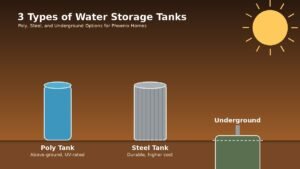
Underground tanks preserve usable yard space but normally require significantly more excavation and installation planning.
You also need to remember the weight.
Water weighs approximately 8.34 pounds per gallon.
A full 1,000-gallon tank therefore holds more than 8,300 pounds of water, before including the weight of the tank itself.
Your tank needs an appropriate base and should be installed according to manufacturer and applicable local requirements.
See our [Rainwater Tanks Phoenix] guide for help comparing tank styles and capacities.
Setting Up Your First-Flush Diverter & Filtration
The first rain after a dry Phoenix period can wash a surprising amount of material from your roof.
That may include:
- Dust
- Pollen
- Leaves
- Bird droppings
- Insects
- Roofing debris
A first-flush diverter prevents the initial portion of runoff from entering your primary tank.
After that first dirty runoff is diverted, cleaner roof water continues toward storage.
University of Arizona guidance specifically recommends considering a first-flush system when collection surfaces contain significant debris or when higher water quality is desired. Screening at the tank inlet is also important for keeping out animals, mosquitoes, and larger debris.
Think of treatment in stages:
- Roof and gutter maintenance
Keep the roof and gutter reasonably clear of leaves, debris, and contamination.
- Leaf screening
Install screens before water enters the main storage system.
- First flush
Divert initial runoff that carries accumulated roof contamination.
- Tank inlet screening
Prevent insects and debris from entering the tank.
- Sediment filtration
Filter water where required by pumps or irrigation equipment.
- Additional treatment where necessary
If water is intended for uses involving higher water-quality requirements, additional filtration and disinfection may be necessary.
Do not assume that clear-looking rainwater is drinking water.
Potable rainwater systems require much more careful design, treatment, testing, and maintenance.
Maintenance Through the Off-Season
Phoenix’s long dry periods make maintenance especially important.
A system that sits unused for months can accumulate dust, leaves, insects, sediment, or clogged components before the next storm.
Before monsoon season:
- Clean gutters.
- Check screens.
- Inspect downspouts.
- Empty and clean the first-flush diverter.
- Check overflow lines.
- Inspect the tank lid.
- Confirm mosquito screening is intact.
- Check pumps and filters.
- Make sure water will drain away from your foundation.
University of Arizona guidance recommends regularly cleaning gutter and downspout screens, draining debris from first-flush devices, clearing strainers, and servicing pump and irrigation filters.
Also inspect the tank itself.
Keep light out of the tank whenever possible. Light encourages algae growth.
Tank openings should remain securely covered while still allowing maintenance access.
After a major storm, walk through the system while water is flowing.
Look for gutter overflow, leaks, erosion, clogged screens, unstable pipes, or overflow going somewhere it should not.
A few minutes of inspection during a storm can reveal problems that are impossible to see during dry weather.
Common Rainwater Harvesting Mistakes to Avoid
1. Buying a Tank Before Calculating Collection
A 2,500-gallon tank sounds impressive, but your roof and rainfall determine whether you can realistically fill it.
Calculate first.
2. Ignoring Overflow
Every tank eventually becomes full.
Your system needs a safe route for excess water.
Overflow should not threaten your foundation, neighboring property, walls, or other structures.
3. Putting the Tank on an Inadequate Base
Thousands of gallons create enormous weight.
Follow tank-manufacturer foundation requirements and applicable local codes.
4. Skipping the First Flush
Phoenix roofs can accumulate significant dust between rain events.
Sending the first runoff directly into your tank can reduce stored-water quality.
5. Leaving Openings Unscreened
Tank openings should be protected against insects, animals, and debris.
6. Assuming All Rainwater Is Potable
Rainwater can become contaminated while falling through the air, contacting your roof, moving through gutters, or sitting in storage.
Landscape irrigation is much simpler than drinking-water use.
7. Forgetting the Overflow Landscape
Your tank and landscaping can work together.
Instead of sending tank overflow uselessly toward the street, consider directing it into properly designed landscape basins where appropriate.
8. Designing for “Average” Rain Only
Phoenix precipitation can be highly irregular.
Design around individual storm capture as well as annual rainfall.
9. Installing Without Checking Local Requirements
Simple systems may be straightforward, but larger tanks, plumbing changes, significant grading, and drainage modifications may require local review.
Start Harvesting Rainwater at Your Phoenix Home
A rainwater harvesting system does not need to be complicated.
You can start with something as simple as redirecting a downspout into a landscaped basin.
Later, you can add a rain barrel.
Then perhaps a larger cistern, pump, filtration, and dedicated irrigation system.
The best system is not necessarily the biggest one. It is the system that captures a useful amount of water, safely manages overflow, fits your property, and provides water where you actually need it.
Start by calculating your roof’s potential with our Water Tank Size Calculator Phoenix, then compare suitable rainwater storage tanks and Phoenix water tank installation options.
A properly designed rainwater harvesting system can turn Phoenix’s occasional storms into a practical source of supplemental landscape water long after the clouds disappear.
Frequently Asked Questions
Can you legally collect rainwater in Arizona?
Yes. The University of Arizona Water Resources Research Center confirms that it is legal to collect rainwater falling on your property in Arizona for future use. Arizona water agencies also encourage rainwater harvesting as a conservation practice. Local permits or approvals may still apply to certain installation work, such as major plumbing, grading, structures, or drainage modifications.
How much rainwater can I legally collect?
Arizona does not impose a general statewide residential gallon limit on ordinary rainwater collected from your own property. The University of Arizona describes property owners as being able to collect rainwater falling on their property and provides guidance for both small rain barrels and large cistern systems. Practical limits usually come from collection potential, property space, tank capacity, installation requirements, and local drainage or building rules.
What are the downsides of rainwater harvesting?
The main disadvantages are upfront equipment costs, limited and unpredictable rainfall, required tank space, maintenance, potential mosquito or algae problems if a system is poorly designed, and the need for filtration or treatment for higher-quality uses. In Phoenix, long dry periods can also mean that a tank remains empty for extended periods. Rainwater harvesting works best as part of a broader water-conservation strategy rather than assuming it will replace all household water demand.
How long before Phoenix becomes uninhabitable?
There is no scientifically established date when Phoenix will suddenly become “uninhabitable.” What scientists and the City of Phoenix do expect is increasing heat risk. Phoenix’s climate planning documents project higher temperatures and more frequent or longer heat waves as the climate warms, while the city’s 2026 Heat Response Plan notes that summer temperatures have risen over several decades and are projected to continue increasing. How livable Phoenix remains will depend partly on emissions, water management, energy reliability, building design, shade, cooling access, public-health measures, and other adaptation efforts.