Installing a water tank can give Phoenix homeowners extra storage for rainwater harvesting, landscape irrigation, emergency supply, or other residential water needs. But the total cost depends on much more than the tank itself.
For a straightforward above-ground water tank installation Phoenix, installation and site-preparation costs may start at a few hundred dollars. Recent Phoenix-area cost data puts many above-ground installations at roughly $415 to $1,040, while underground installations can run approximately $1,550 to $3,100 or more because of excavation and additional site work. Complex plumbing, pumps, electrical connections, concrete foundations, difficult access, or larger tanks can push costs higher. These figures should be treated as planning estimates rather than contractor quotes.
The basic process involves assessing the site, preparing a stable base, positioning the tank, connecting the required plumbing and overflow, testing the system, and completing any required inspections.
Here is what Phoenix homeowners should know before installation begins.
What Affects Water Tank Installation Cost in Phoenix?
There is no single installation price that applies to every property.
Two homes installing identical 1,000-gallon tanks can have very different costs depending on access, foundation requirements, plumbing distances, excavation, and how the tank will be used.
The largest cost factors are usually tank size and material, installation type, and site preparation.
Tank Size & Material
Tank capacity affects both the purchase price and installation cost.
A smaller tank may be light enough to position with minimal equipment. A large tank can require additional workers, specialized delivery equipment, or machinery to move it into place.
Remember that the tank becomes extremely heavy when filled.
Water weighs about 8.34 pounds per gallon, which means:
- 500 gallons weighs about 4,170 pounds
- 1,000 gallons weighs about 8,340 pounds
- 2,500 gallons weighs about 20,850 pounds
That weight makes proper site preparation essential.
Tank material can also affect installation.
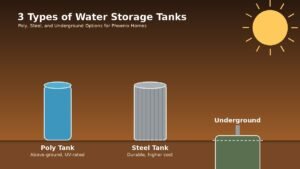
Polyethylene water tanks are popular for residential storage because they are relatively lightweight before filling and resist corrosion. Steel, fiberglass, concrete, and other tank types may require different foundations, handling equipment, or installation methods.
If you have not selected your capacity yet, use our Water Tank Size Calculator Phoenix before requesting installation quotes.
Above-Ground vs. Underground Installation
Above-ground tanks are generally the least complicated and most affordable option.
A typical installation might require:
- Site leveling
- A compacted aggregate or concrete base
- Tank placement
- Inlet and outlet plumbing
- Overflow piping
- Pump installation if needed
Because excavation is limited, labor and equipment requirements can be relatively modest.
Recent Phoenix cost estimates place basic above-ground tank installation around $415 to $1,040, although larger or more complicated projects can cost substantially more.
Underground tanks are different.
Installation can require:
- Excavation
- Soil removal
- Excavation equipment
- Bedding material
- Tank anchoring where appropriate
- Backfilling
- Plumbing
- Access risers
- Surface restoration
Underground installation costs in Phoenix may start around $1,550 to $3,100, with complex projects going considerably higher.
The tank itself may also cost more if it is specifically engineered for underground use.
Never bury an above-ground tank unless the manufacturer specifically rates it for underground installation.
Site Preparation: Leveling, Base & Access
Site conditions are one of the biggest sources of unexpected installation costs.
A water tank needs a stable, level base capable of supporting thousands of pounds without settling unevenly.
Depending on the tank manufacturer and installation design, the base may consist of:
- Compacted aggregate
- Concrete
- Engineered foundation material
- A reinforced structural pad
The site also needs adequate drainage.
Water should not collect around the tank foundation or be directed toward the home’s foundation.
Access can affect pricing too.
If an installer can unload the tank directly beside the installation location, placement may be simple.
If the tank has to pass through a narrow side yard, over a wall, behind a house, or into an area inaccessible to a delivery truck, additional equipment or labor may be needed.
Before ordering a large tank, measure gates, driveways, overhead obstructions, utility lines, and the route from the delivery point to the installation site.
The Water Tank Installation Process, Step by Step
Professional installation varies by tank and property, but most residential projects follow the same basic sequence.
Site Assessment
Installation should start with evaluating the property.
The installer will typically consider:
- Desired tank capacity
- Available space
- Tank dimensions
- Ground conditions
- Delivery access
- Gutter and downspout locations
- Plumbing requirements
- Pump requirements
- Overflow location
- Nearby structures
- Utility lines
For rainwater harvesting, the installer should also consider where runoff originates and where excess water will go when the tank becomes full.
Tank overflow is not an optional detail.
A poorly located overflow can cause erosion, create drainage problems, or direct water toward structures.
For a complete rainwater system overview, see our Rainwater Harvesting Phoenix guide.
Base/Foundation Preparation
Once the location is selected, the site is prepared according to the tank manufacturer’s requirements.
The base must be level and capable of carrying the tank’s full operating weight.
For some small tanks, properly prepared compacted material may be appropriate.
Larger installations may call for concrete or another engineered base.
This is one area where cutting costs can become expensive later.
If the base settles unevenly, the tank can tilt, fittings can be stressed, plumbing can move, and the tank itself may be damaged.
Underground tanks require significantly more preparation because excavation depth, bedding, soil conditions, backfill, and manufacturer specifications must all be considered.
Placement & Plumbing Connection
Once the foundation is ready, the tank is positioned.
For a basic rainwater harvesting system, plumbing may include:
Roof → gutters → downspout → debris screen → first-flush diverter → tank inlet
The tank may then have connections for:
- Outlet valve
- Pump
- Irrigation
- Overflow
- Drain
- Level indicator
If the system connects to residential water piping, permanent plumbing, electrical pumps, or other building systems, the project becomes more technically involved.
Arizona’s Registrar of Contractors identifies plumbing classifications that cover water piping and tank-related work. The state’s contractor classifications include plumbing work involving water-supply piping and tanks, so homeowners hiring for this type of work should verify that the contractor holds an appropriate active Arizona license.
Final Inspection
The final step is testing the completed system.
The installer should check:
- Tank stability
- Inlet connections
- Outlet connections
- Valves
- Overflow
- Pumps
- Filters
- Leaks
- Drainage
- Electrical components where applicable
For rainwater systems, it is particularly important to confirm that overflow water has a safe destination.
If the project required a City of Phoenix permit, permitted residential work is subject to the city’s applicable inspection process.
Permits & Regulations in Maricopa County
Permit requirements are determined partly by where your property is located and the scope of the installation.
A property with a Phoenix mailing address is not automatically governed by Maricopa County’s residential building department. Properties inside incorporated Phoenix generally follow City of Phoenix requirements, while properties in unincorporated Maricopa County use the county permitting system. Maricopa County explicitly tells applicants to use the relevant city or town permitting process when the property is located within an incorporated municipality.
For unincorporated Maricopa County, residential permit categories include plumbing, water/septic tanks, grading, and stormwater drainage.
Within Phoenix, requirements depend on the project.
Homeowners can check the City of Phoenix Residential Projects and Permits guidance before starting installation. The city explains which types of residential improvement work may require permits and inspections and provides resources for determining the requirements for a specific project.
The city’s residential guidance states that many construction and plumbing projects require permits and inspections. Phoenix also notes that grading and drainage permits may be required for applicable projects.
For rainwater harvesting specifically, the City of Phoenix’s residential green stormwater handbook lists ordinary rain barrels and gutter systems on private property as not requiring a city permit. Larger tanks, substantial site modifications, permanent plumbing, structures, grading, or work affecting the public right-of-way may be treated differently.
Because requirements depend on the individual installation, verify permit requirements for your address before beginning major work.
DIY vs. Hiring a Professional
Not every water tank installation requires the same level of expertise.
A small rain barrel and a multi-thousand-gallon pressurized water-storage system should not be treated as equivalent DIY projects.
When DIY Might Be Reasonable
DIY installation may be practical for a small, simple system such as:
- A rain barrel
- Small above-ground storage
- Basic gravity-fed landscape watering
- Simple gutter diversion
- A system without permanent household plumbing
Even then, the tank needs a stable foundation and properly designed overflow.
A 200-gallon tank weighs more than 1,600 pounds when full. Improvised stands or unstable blocks are not appropriate foundations.
Homeowners should also locate underground utilities before digging.
When You Should Hire a Licensed Contractor
Professional installation becomes increasingly valuable when the project involves:
- Large tanks
- Underground tanks
- Significant excavation
- Concrete foundations
- Permanent plumbing
- Electrical pumps
- Pressure systems
- Connections to household systems
- Major grading
- Difficult access
- Permit-required construction
Arizona requires businesses performing regulated contracting work to be properly licensed for the work they offer. The Arizona Registrar of Contractors also provides a license lookup homeowners can use before hiring.
Questions to Ask an Installer Before Hiring
Do not compare contractors based only on the lowest price.
Ask:
- Are you licensed in Arizona for this type of work?
- Is your quote for labor only or does it include the tank?
- Is site preparation included?
- What type of foundation will you install?
- Who handles permit applications if permits are required?
- Is excavation included?
- Will you connect gutters and downspouts?
- Does the price include pumps or filtration?
- Where will tank overflow discharge?
- Are plumbing materials included?
- Does the quote include delivery and tank placement?
- What warranty applies to the installation?
- What is excluded from the quoted price?
The most useful estimate is a written quote that clearly separates the tank, delivery, foundation, labor, plumbing, electrical work, permits, excavation, equipment, and other costs.
Get the Right Water Tank Installed in Phoenix
The best installation starts before the tank arrives.
Calculate how much storage you actually need, choose a tank designed for your intended use, confirm that it can reach the installation location, and prepare a foundation capable of supporting its full weight.
For a simple above-ground system, installation may cost several hundred dollars. Larger above-ground projects can exceed $1,000, while underground installations can easily move beyond $1,500 to $3,000 depending on excavation and site conditions.
Before purchasing, use our Water Tank Size Calculator Phoenix to estimate your ideal capacity. Then explore Water Tanks Phoenix or contact our team to discuss tank options and installation requirements for your property.
Frequently Asked Questions
Do I need a permit to install a water tank in Phoenix?
It depends on the installation. City of Phoenix guidance shows that ordinary private-property rain barrels and gutter systems do not require a city permit, while larger construction, plumbing, grading, drainage, or other site modifications may require permits or approvals. Check your specific project with the City of Phoenix Planning & Development Department before starting major work.
How long does water tank installation typically take?
A straightforward above-ground tank on a prepared site may sometimes be placed and connected within a day. Projects requiring concrete curing, excavation, extensive plumbing, electrical work, permits, inspections, or underground installation can take substantially longer. Ask the installer whether the quoted schedule includes site preparation and permitting rather than only tank placement.
Can I install a water tank myself?
A small above-ground rain barrel or simple non-pressurized landscape storage system may be suitable for an experienced DIY homeowner. Larger tanks, underground installations, major excavation, permanent plumbing, pumps, structural foundations, and permit-required work are generally better handled by qualified professionals.
What’s the difference in cost between above-ground and underground water tank installation?
Above-ground installation is normally considerably less expensive because excavation and backfilling are not required. Recent Phoenix estimates place above-ground installation around $415–$1,040 compared with approximately $1,550–$3,100 for underground installation, although actual quotes can fall outside these ranges depending on tank size and property conditions.
Does the installation price include the water tank?
Not always. Some estimates combine the tank, materials, and labor, while others quote installation separately. Ask for an itemized proposal showing tank cost, delivery, site preparation, foundation, placement, plumbing, pump equipment, excavation, permits, and labor so you can compare quotes accurately.