
- Introduction
If you’ve ever walked into your utility room and spotted a puddle near your heater, your first question is likely why hot water tank leaking. This is one of the most common home maintenance problems. A leaking tank can waste water, increase utility bills, and even damage flooring or walls if ignored.
In most cases, leaks occur because of high internal pressure, corrosion, or a worn-out valve. But pinpointing the exact reason can save you from unnecessary repairs or even full replacement. This guide will help you identify the cause, fix the problem safely, and prevent future leaks—all explained in simple terms by plumbing professionals.
2. Quick Answer: Why Hot Water Tank Leaking?
Your hot water tank is leaking because one of its key components—like the drain valve, temperature and pressure (T&P) valve, or the tank body—has failed. The most frequent causes are:
- Excessive internal water pressure
- Corrosion from hard water or age
- Faulty drain or relief valve
According to U.S. home maintenance data (2024–2025), nearly 1 in 5 homeowners experience water heater leaks every year, usually after the unit reaches 8–12 years of use.
3. Step 1: Check If It’s a Leak or Condensation
Before assuming the worst, confirm whether you truly have a leak or just harmless condensation.
Condensation on Electric Water Heaters
Electric heaters often sweat when the surrounding air is humid. If moisture is forming evenly across the outer tank surface, wipe it off and check again after an hour. If it returns slowly and evenly, it’s condensed.
Condensation on Gas Water Heaters
For gas models, moisture may appear around the burner area during startup. If it disappears as the tank heats, it’s condensation—not a leak.
Tip: Place a dry paper towel beneath the tank and check it after a few hours. A wet spot indicates an actual leak.
4. Step 2: Turn Off Power and Water Supply Safely
Before inspecting or repairing any leaks, safety comes first.
- For Electric Water Heaters:
Turn off the breaker from your main electrical panel. Never touch wet surfaces before cutting power. - For Gas Water Heaters:
Locate the gas shut-off valve and turn it clockwise to close.
Next, shut off the cold-water inlet valve (usually found on the top of the tank). This stops water from entering the system and prevents further leakage.
5. Step 3: Locate the Source of the Leak
Once the tank is safe to handle, inspect it from top to bottom. The location of the leak usually indicates the root cause.
Leaks from the Top
If you see water pooling at the top, the issue might be with:
- A loose cold-water inlet or hot-water outlet pipe
- A leaking T&P valve
- Or rusted fittings
Leaks from the Side
Leaks around the midsection often point to corroded fittings, cracked pipes, or condensation drainage lines.
Leaks from the Bottom
If you’re wondering why a hot water tank is leaking from the bottom, this usually signals a drain valve leak, sediment buildup, or a cracked internal lining.
6. Common Causes — Why Hot Water Tank Leaking Happens
Below are the most frequent culprits behind water tank leaks.
- Faulty Drain Valve – A worn or loose drain valve can allow water to seep out slowly.
- Cracked or Corroded Tank – Over time, minerals in water cause corrosion that eats through metal.
- High Water Pressure – Excessive pressure strains the tank, often triggering leaks at the weakest point.
- Sediment Buildup or Hard Water – Minerals settle at the bottom, causing overheating and small cracks.
- Loose Pipe Fittings – Vibrations or thermal expansion may loosen threaded joints.
- Worn-Out Anode Rod – The anode rod protects your tank from rust; when depleted, corrosion starts.
- Damaged Temperature & Pressure (T&P) Valve – This valve releases excess pressure; if faulty, it leaks continuously.
7. Signs Your Hot Water Tank Is Leaking (or About to Leak)
Even before water starts dripping, your heater gives warning signs:
- Damp spots or puddles near the base
- Rust stains around valves or fittings
- Metallic-tasting or discolored water
- Strange popping or banging sounds
- Drop in hot water pressure or temperature
- Increased utility bills due to heat loss
If you notice more than one of these, your tank is likely near failure.
8. Step-by-Step Fixes for Hot Water Tank Leaks
You can handle minor issues yourself before calling a plumber.
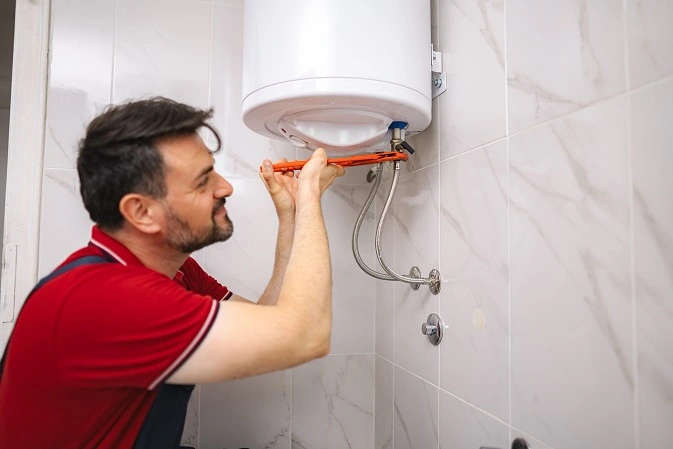
Tighten Loose Fittings
Use a wrench to snug up any visible pipe joints or connections, but avoid overtightening.
Replace the T&P Valve
If water leaks through the overflow pipe, the T&P valve may be defective. Turn off power and water, unscrew the old valve, and replace it with a matching part.
Replace the Drain Valve
Attach a garden hose, drain the tank, remove the old valve, and install a new brass one.
Lower Water Pressure
Use a pressure gauge to ensure your home’s water pressure stays below 80 psi. Install a regulator if needed.
Replace the Tank
If the tank itself is cracked or corroded, replacement is the only safe solution. Most water heaters last 8–12 years, and after that, internal rust often causes irreversible leaks.
9. Preventing Future Hot Water Tank Leaks
Preventing leaks is simpler and cheaper than repairs. Follow these steps:
- Flush your tank every 6–12 months to remove sediment buildup.
- Inspect the anode rod annually and replace it if over 50% corroded.
- Test the T&P valve once a year to ensure it opens and closes properly.
- Check for corrosion on fittings and around the base.
- Install a pressure regulator if your home has high incoming water pressure.
For further maintenance tips, read our related guide:
👉 How to Clean Your Water Tank at Home
Read more: Hot Water Tank Leaking
10. Real-Life Case Study (U.S. Example)
Case:
A homeowner in Texas noticed a small puddle beneath their 10-year-old electric water heater. After inspection, a plumber found that the drain valve was slowly leaking due to mineral buildup. The homeowner replaced the valve for $25 and avoided a complete tank replacement that would have cost over $1,000.
Lesson:
Quick inspection and simple repairs can save hundreds of dollars and prevent major water damage.
11. Repair or Replace — What’s Better?
If your unit is under 8 years old, most leaks can be repaired. But if it’s beyond 10 years or shows visible corrosion, it’s more practical to replace.
Average U.S. water heater replacement cost (2025):
- Standard tank: $1,000–$1,600
- Tankless system: $1,800–$3,000
Always compare repair costs to the unit’s age—if repair costs exceed 40% of replacement, it’s time for a new system.
12. Conclusion
Now you know why hot water tank leaking happens and how to fix it safely. In most cases, leaks stem from pressure buildup, corrosion, or valve failures. Addressing these early prevents costly damage and extends your heater’s life.
Remember, regular maintenance is your best defense—flush the tank, check fittings, and schedule professional inspections annually.
13. FAQs — Why Hot Water Tank Leaking
1. Why is the hot water tank leaking from the bottom?
Usually caused by a faulty drain valve, corrosion, or a cracked inner tank.
2. Can I repair a leaking hot water tank myself?
You can fix small valve or fitting leaks, but internal corrosion needs professional replacement.
3. Why is the hot water tank leaking only when heating?
Pressure expands during heating cycles; faulty T&P valves often release water at that point.
4. Is it dangerous if my hot water tank leaks?
Yes. Electrical risk, water damage, and mold growth can occur if ignored.
5. How can I prevent the hot water tank from leaking again?
Flush the tank annually, check valves, and inspect the anode rod regularly.
14. Summary
Wondering why hot water tank leaking issues keep happening?
It’s often due to high water pressure, corrosion, or worn valves.
With quick action and proper maintenance, you can prevent leaks, protect your home, and extend your water heater’s lifespan.
External References
According to the U.S. Department of Energy, following a regular maintenance schedule—including tank flushing, valve testing, and anode rod inspection—can extend your water heater’s life and prevent leaks.

Ethan Wells is the author of Water Tank Guides, a blog focused on practical tips for water tank cleaning, maintenance, and installation. His mission is to help readers keep their water clean, safe, and their tanks long-lasting through simple, easy-to-follow guides.