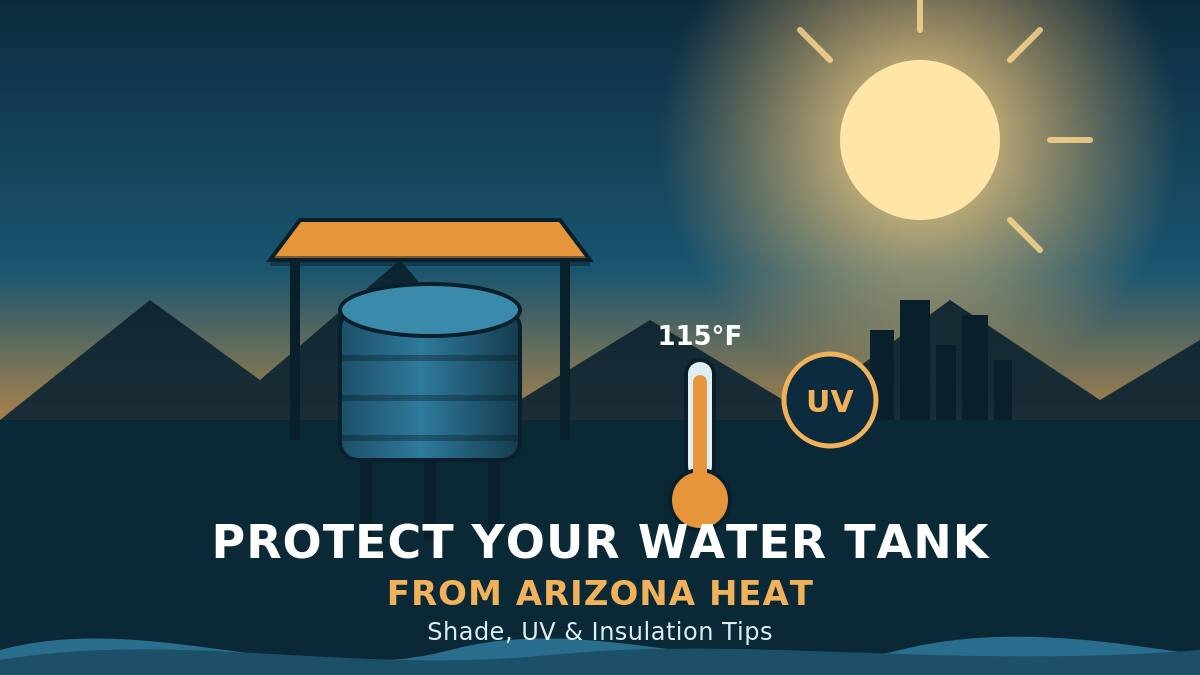
The most effective way to protect an outdoor water tank from Arizona heat is to keep direct sunlight off the tank, use a tank rated for long-term outdoor UV exposure, and protect sun-exposed pipes and fittings. Insulation and compatible reflective coatings can provide additional protection, but they work best after direct solar exposure has been reduced.
Phoenix does not give outdoor water tanks much of a break during summer. National Weather Service data show that Phoenix’s average maximum temperature in August 2026 was 109.4°F, with a monthly high of 117°F. The area’s long-term summer climate also includes routine triple-digit afternoons.
That matters because an above-ground tank is exposed to two different stresses at once: high ambient temperature and intense solar radiation.
The goal, therefore, is not simply to “keep the water cold.” In Phoenix, that may be unrealistic without active cooling. A better goal is to reduce unnecessary solar heat gain, protect the tank material from UV exposure, keep light out of stored water, and prevent heat-related wear on pipes, fittings, seals and other exposed components.
What Does Arizona Heat Actually Do to a Water Tank?
Heat and sunlight affect different tank materials in different ways.
For polyethylene tanks, UV exposure is one of the main long-term concerns. Norwesco states that its polyethylene resin is UV stabilized, but also notes that sheltering a tank can prolong its life. The manufacturer specifically identifies Arizona as an example of a location where outdoor tanks are exposed to more intense sunshine and says UV exposure can reduce the service life of polyethylene tanks.
Snyder Industries similarly manufactures UV-stabilized polyethylene tanks for long-term outdoor service and notes that environment, temperature and UV exposure can influence tank life.
Stored water can also become substantially warmer when a tank and its plumbing sit in direct sun. That does not automatically make the water unsafe, but temperature becomes one part of water-quality management, particularly where potable water sits stagnant for extended periods.
For building potable-water systems, the CDC identifies warm water, stagnation, sediment and loss of disinfectant as factors that can support Legionella growth. Its guidance identifies 77°F to 113°F as the range in which Legionella grows best.
That is a reason to manage stored potable water properly—not a reason to assume that every warm Arizona tank is contaminated.
1. Shade the Tank Before You Do Anything Else
For most exposed tanks in Phoenix, blocking direct sunlight is the first improvement to consider.
A tank sitting in 105°F air will eventually become warm. But a tank sitting in that same air while also absorbing hours of direct desert sun faces an additional radiant heat load and UV exposure.
Shade can come from:
- An open-sided tank shelter
- A properly designed canopy
- An adjacent structure that blocks afternoon sun
- A pergola-style roof
- A manufacturer-compatible tank enclosure
The structure does not need to completely box in the tank. In fact, leaving room for airflow, inspection and maintenance is useful.
Keep access to the lid, vent, inlet, outlet and overflow clear.
University of Arizona Cooperative Extension recommends covering tank openings, keeping light out of the water, maintaining appropriate overflow arrangements and using UV-resistant above-ground tanks.
Don’t forget Arizona wind
A shade roof that works on a calm June afternoon also has to survive Arizona’s monsoon season.
University of Arizona guidance specifically notes that tanks in windy areas may need to be secured. Any permanent shade structure should likewise be appropriately anchored for its site and local requirements.
If installing a substantial structure requires concrete footings, electrical relocation, major plumbing changes or structural work, use an appropriate licensed professional rather than treating it as a casual DIY project.
2. Make Sure a Poly Tank Is Actually Rated for Outdoor UV Exposure
Not every plastic container is suitable for sitting outside in Phoenix year after year.
When reviewing an existing polyethylene tank, check the manufacturer’s documentation for terms such as:
- UV stabilized
- UV resistant
- Outdoor service
- Potable-water rated, if applicable
- Above-ground use
Do not assume that a plastic container is suitable simply because it can physically hold water.
Commercial tank manufacturers such as Snyder specify UV stabilization for tanks intended for long-term outdoor service, while Norwesco emphasizes that UV intensity and geographic location affect polyethylene tank life.
Watch for signs of weathering
During your summer inspection, look for:
- Unusual surface chalking
- Brittleness
- Small cracks
- Deformation
- Damage around fittings
- Leaks at penetrations
- A deteriorating lid or vent
Do not climb onto or strike an aging polyethylene tank to “test” it. If the shell appears brittle or structurally questionable, contact the manufacturer, distributor or a qualified tank professional.
3. Don’t Choose Tank Color Based on Heat Alone
You’ll often see advice saying:
“Use a white tank because black tanks get hotter.”
That is only part of the issue.
A lighter exterior generally absorbs less solar energy than a dark exterior, but stored-water tanks also need to prevent sunlight from penetrating into the water.
University of Arizona Cooperative Extension notes that light promotes algae growth and recommends excluding light from storage tanks. Its rainwater guidance actually points out that darker tanks can be effective at keeping light out.
That creates an important Arizona trade-off.
You want:
low solar heat gain + high opacity + UV resistance.
For an existing dark, opaque tank, replacing it solely because of color may make less sense than simply giving it effective shade.
For a new tank, compare the manufacturer’s specifications rather than shopping by color alone.
4. Consider a Compatible Reflective Exterior Coating
If shade cannot eliminate enough exposure, a suitable exterior coating may provide another layer of protection.
University of Arizona Cooperative Extension notes that above-ground tanks should be UV resistant and states that tanks can be painted with rubberized paint to provide sun protection.
However, that does not mean every white roof coating, household paint or reflective product belongs on every polyethylene tank.
Before painting:
- Identify the tank material.
- Check the manufacturer’s coating instructions.
- Verify that the coating is compatible with the tank surface.
- Apply coating only where approved.
- Keep vents, labels, fittings and inspection points functional.
For potable-water tanks, never apply an unapproved coating to the inside of the tank.
A reflective exterior treatment and an opaque potable-water liner are two very different things.
5. Use Insulation for Heat Transfer—Not as a Substitute for Shade
Insulation can help, particularly when very hot ambient air surrounds the tank for long periods.
But insulation does something specific: it slows heat transfer.
It does not manufacture cold water.
That distinction matters in Phoenix, where nighttime temperatures during severe summer heat can remain very high. Community discussions from people dealing with 110°F-plus conditions repeatedly raise this exact issue: insulation can slow warming, but it cannot indefinitely keep a tank below the surrounding environment.
For that reason, a sensible order is:
- Block direct sunlight.
- Protect against UV.
- Then consider insulation if stored-water temperature remains a problem.
If installing an insulation jacket or radiant barrier, choose a product intended for outdoor tank applications and install it according to the tank and insulation manufacturers’ directions.
6. Protect the Pipes Too
Sometimes the tank gets all the attention while several feet of water line remain fully exposed to the afternoon sun.
That can undermine your efforts.
A small volume of water sitting inside an exposed pipe can heat much faster than hundreds or thousands of gallons inside a large tank.
Inspect:
- Supply lines
- Outlet pipes
- Exposed PVC
- Pump connections
- Valves
- Filter housings
- Flexible connectors
University of Arizona guidance specifically recommends weatherizing pipes and outlets against UV degradation.
Use pipe insulation or another UV/weather protection method appropriate for the plumbing material and exterior environment.
If plumbing is part of a potable-water system, use materials approved for that application.
7. Keep the Tank Opaque, Covered and Properly Sealed
Heat protection should never compromise water-quality protection.
University of Arizona guidance recommends covering storage tank openings because this helps reduce evaporation and exclude light. Light inside the tank can support algae growth.
Check that:
- The lid closes correctly.
- Openings are protected from debris and animals.
- Screens remain intact where required.
- Sunlight is not entering through damaged or translucent openings.
- The vent remains functional.
- Overflow plumbing remains unobstructed.
Do not seal a vented tank into an airtight container unless the tank was specifically designed to operate that way.
8. Pay Extra Attention to Potable-Water Tanks
A rainwater tank used only for landscape irrigation and a tank supplying household drinking water do not have identical water-quality requirements.
University of Arizona Cooperative Extension recommends periodic inspection, cleaning and disinfection of fresh-water storage tanks and provides specific procedures for stored potable water.
For drinking-water storage, heat protection should therefore be only one part of the maintenance plan.
Also consider:
- Water age
- Sediment
- Biofilm
- Disinfection
- Tank cleanliness
- Water testing when appropriate
If stored water develops an unusual odor, color, taste or visible growth, do not assume that cooling the tank will solve the underlying problem.
Have the system evaluated and, where appropriate, test the water.
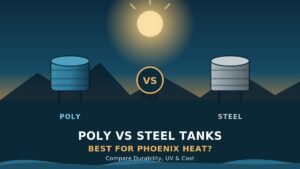
Poly vs. Steel Tanks in Phoenix Heat
| Issue | Polyethylene Tank | Steel Tank |
| Direct sun | Adds heat and UV exposure | Adds substantial solar heat |
| UV concern | Important long-term consideration | Tank shell itself is not degraded like polyethylene by UV |
| Main exterior concern | UV aging and fitting deterioration | Coating deterioration and corrosion |
| Shade helpful? | Yes | Yes |
| Exterior coating | Must be compatible with polyethylene | Appropriate protective/reflective coating may help |
| Inspection focus | Brittleness, cracks, deformation, fittings | Rust, coating failure, seams and fittings |
For either material, shade is valuable because it reduces direct solar exposure without changing the tank’s potable-water contact surfaces.
A Practical Phoenix Summer Protection Plan
If you already have an outdoor tank, you do not necessarily need to redesign the entire system.
Work through the following sequence.
Step 1: Check the tank specification
Confirm that it is intended for outdoor, above-ground use and that a polyethylene tank includes UV stabilization.
Step 2: Map its sun exposure
Look at the tank in the morning, around midday and during late afternoon.
Phoenix’s western afternoon sun can expose a tank even when it appeared shaded earlier in the day.
Step 3: Add effective shade
Prioritize the portions of the day with the strongest direct exposure while maintaining airflow and service access.
Step 4: Inspect exposed plumbing
Protect pipes, valves and components that sit in direct sun.
Step 5: Evaluate coating or insulation
Only after shade and material suitability are addressed should you decide whether additional reflective protection or insulation is worth installing.
Step 6: Inspect water-quality safeguards
Make sure lids, screens, vents and overflow components remain in good condition.
Step 7: Repeat the inspection periodically
Arizona’s combination of UV exposure, heat, dust and summer storms makes visual inspection worthwhile, especially before peak summer and after damaging weather.
Mistakes to Avoid
Avoid these common shortcuts:
- Using an indoor-only tank outdoors
- Assuming “plastic” automatically means UV resistant
- Blocking the tank vent while adding a cover
- Covering the overflow
- Painting polyethylene without checking coating compatibility
- Applying unapproved material inside a potable-water tank
- Relying on tank color alone
- Expecting insulation to keep water cold indefinitely
- Ignoring exposed pipes and fittings
- Building an unsecured shade structure in a monsoon-prone environment
The best solution is usually not one product. It is a combination of shade, proper tank selection, UV protection, protected plumbing and routine inspection.
Frequently Asked Questions
Can Arizona heat damage a polyethylene water tank?
Yes, long-term UV exposure can shorten the service life of polyethylene. UV-stabilized tanks are designed for outdoor service, but manufacturers still note that intense sunlight—such as that experienced in Arizona—can affect tank longevity. Shading the tank can reduce exposure.
Should I paint my plastic water tank white?
Not automatically. A lighter exterior can reduce solar heat absorption, but a water tank also needs to remain sufficiently opaque to keep sunlight out. Use only a coating compatible with your particular polyethylene tank and follow the manufacturer’s instructions. University of Arizona guidance notes that suitable rubberized paint may be used for sun protection on poly tanks.
Does water tank insulation work in Phoenix?
Insulation can slow heat transfer, so it can be useful. However, it cannot permanently keep stored water cooler than a very hot surrounding environment. Blocking direct sun first usually addresses the largest avoidable heat load.
Is a black water tank bad for Arizona?
Not necessarily. A dark tank may absorb more solar energy, but an opaque dark wall is also effective at excluding light. A properly shaded, UV-stabilized dark tank may therefore perform better than an unshaded lighter tank that allows significant light penetration. Choose according to the complete tank specification rather than color alone.
Can hot stored water become unsafe?
Temperature alone does not tell you whether water is safe. For potable-water systems, however, warm temperatures combined with stagnation, inadequate disinfectant, sediment or biofilm can create conditions favorable to microbial growth. The CDC therefore treats temperature as one part of overall potable-water management.
Should I bury my water tank to protect it from Arizona heat?
Only use a tank specifically designed and rated for underground installation. University of Arizona guidance warns that underground storage tanks must be rated for that use. Excavation, drainage, soil loading and plumbing make underground installation a project that should be designed for the site rather than treated as a simple cooling shortcut.
Bottom Line
For Phoenix homeowners, protecting a water tank from summer heat starts with reducing direct sunlight, not trying to mechanically cool thousands of pounds of stored water.
Use an outdoor-rated, UV-stabilized tank; provide effective shade; protect exposed pipes and fittings; keep the tank opaque and properly covered; and add compatible coatings or insulation only where they solve a specific problem.
Arizona’s heat is unavoidable. Unnecessary solar exposure is not.
Internal-Link
- water tank cleaning and maintenance
- choosing the right water tank size
- rainwater harvesting in Phoenix
Main inke exact URLs guess nahi kar raha, kyunki current homepage crawl par several guide/category buttons destination ki jagah homepage par resolve ho rahe hain. Publish se pehle actual live URLs add karke test karein. Aapki homepage par six intended guide areas clearly Water Tanks, Water Tank Sizing, Rainwater Harvesting, Installation, Maintenance aur Water Storage ke taur par defined hain.
Credible outbound sources used
University of Arizona — Rainwater Harvesting guidance
University of Arizona — Water Storage Tank Maintenance
National Weather Service Phoenix climate data
CDC potable-water temperature guidance
Arizona Department of Water Resources water-harvesting guidance
Norwesco polyethylene tank guidance