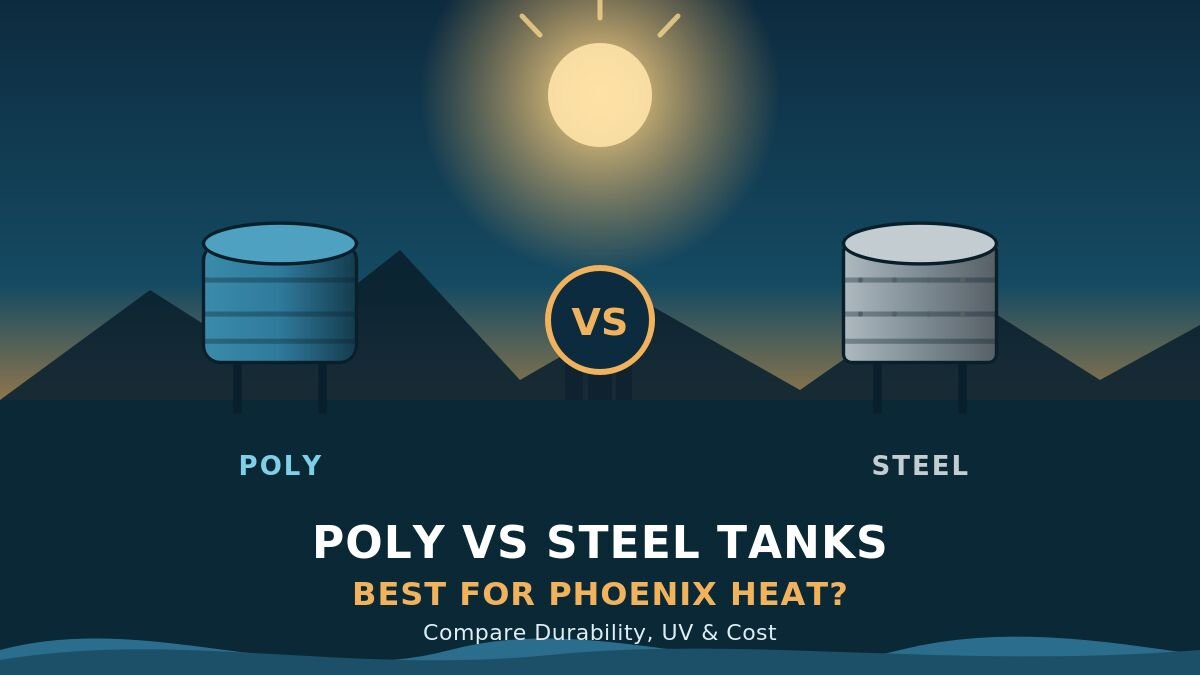
For most residential above-ground water storage in Phoenix, a properly rated, opaque, UV-stabilized polyethylene tank is usually the simpler option because it cannot rust, is comparatively light, and requires less coating-related maintenance. Steel becomes more attractive when you need very large capacity, structural strength, or a custom tank—but Phoenix heat does not make either material automatically superior. Shade, exterior finish, tank design, and maintenance can matter as much as the material itself.
Choosing between a poly and steel water tank in Phoenix is not simply a question of which material “handles heat better.”
Phoenix regularly experiences summer temperatures above 100°F. National Weather Service climate normals put the normal July average high at about 106.5°F, while individual summer days can climb considerably higher.
At those temperatures, an outdoor tank has to deal with more than hot air. It also faces intense sunlight, ultraviolet radiation, thermal cycling, dust and seasonal monsoon weather.
Polyethylene and steel respond differently to those stresses.
Poly does not rust and transfers heat relatively slowly, but prolonged UV exposure can shorten its life if the tank is not properly stabilized or protected. Steel is structurally strong and unaffected by UV degradation in the way polyethylene is, but it conducts heat readily and depends heavily on coatings, liners and corrosion control.
So the better question is:
Which set of trade-offs fits your Phoenix property?
Poly vs. Steel Water Tanks at a Glance
| Feature | Polyethylene Tank | Steel Tank |
| Rust | Does not rust | Can corrode if protection fails |
| UV exposure | Must be UV stabilized | Steel itself is not UV-degraded |
| Heat transfer | Relatively low | Much higher |
| Weight | Relatively light | Heavy |
| Installation | Usually simpler for residential sizes | Often requires more site preparation |
| Custom sizes | Limited by available molds | Highly customizable |
| Very large capacities | Less practical as size increases | Strong option |
| Coating maintenance | Usually minimal | Protective coating/liner may require maintenance |
| Potable water | Suitable when product is approved for potable use | Suitable with appropriate tank system/coatings |
| Phoenix fit | Strong for typical residential storage | Strong for larger or specialized systems |
The comparison is not absolute. The design of the specific tank matters more than simply seeing the word poly or steel on a specification sheet.
water storage tank types, sizes and prices in Phoenix
How Phoenix Heat Affects Poly Water Tanks
Most residential plastic storage tanks are made from polyethylene.
University of Arizona Cooperative Extension identifies polyethylene as one of the common materials used for above-ground water storage in Arizona. It also notes that molded poly tanks are relatively lightweight compared with many alternatives.
The main Phoenix concern is UV exposure
A properly manufactured outdoor poly tank contains UV stabilization, but UV stabilization does not make the material completely immune to decades of sunlight.
Norwesco, a major polyethylene tank manufacturer, states that its resin is UV stabilized while also recommending sheltering tanks where practical to extend their useful life. The manufacturer specifically notes that tanks outdoors in Arizona receive more intense sunshine than tanks in places such as Minnesota, and that UV exposure negatively affects polyethylene over time.
That makes the specification important.
For an outdoor Phoenix installation, look for manufacturer documentation stating that the tank is intended for:
- Outdoor use
- Above-ground installation
- Long-term UV exposure
- The liquid being stored
- Potable water, if drinking water is involved
A generic plastic container should not be treated as equivalent to a purpose-built water storage tank.
Poly handles corrosion well
One major advantage of polyethylene is simple:
It does not rust.
That removes one maintenance concern that comes with carbon or galvanized steel.
This can be valuable in a water-storage application because the tank continuously contains water and may also be exposed to irrigation, rain or condensation on the exterior.
Poly is also a poor heat conductor compared with steel
Bulk polymers generally have low thermal conductivity compared with metals. Published material-property data place ordinary HDPE far below carbon steel in thermal conductivity.
In practical terms, a poly tank wall does not transfer external heat into the water as rapidly as an equivalent bare metal wall.
But that does not mean a poly tank stays cool in the Phoenix sun.
A dark tank sitting in direct afternoon sunlight can still absorb substantial solar energy. Over enough time, hundreds or thousands of gallons of water can become warm regardless of tank material.
That is why shade and exterior exposure should be considered separately from material.
How Phoenix Heat Affects Steel Water Tanks
Steel avoids one major weakness of polyethylene:
Sunlight does not degrade the steel shell through UV exposure.
But steel introduces different considerations.
Steel transfers heat efficiently
Metal is a much better heat conductor than conventional polyethylene.
That means the steel wall can respond rapidly to solar heating and changes in ambient temperature.
This is one reason exterior color and coating become especially important.
University of Arizona’s water-storage guidance includes an example of an above-ground steel tank painted white specifically to reflect sunlight.
A reflective steel tank under shade therefore behaves very differently from an uncoated dark metal tank sitting in full western sun.
Corrosion is the bigger long-term concern
Unlike polyethylene, steel can corrode.
That does not mean steel water tanks are inherently unreliable. Properly designed steel water-storage systems use coatings, linings, galvanizing and, in larger installations, other corrosion-control methods.
The American Water Works Association maintains specific standards addressing protective coatings for steel water-storage tanks and cathodic protection of submerged steel surfaces.
The existence of these standards illustrates an important ownership difference:
Corrosion management is part of owning a steel tank.
If an exterior coating begins to fail or the interior protective system becomes damaged, the underlying metal needs attention.
University of Arizona guidance also notes that warm water conditions can favor corrosion and shows visible rust inside a water storage tank as part of its maintenance guidance.
Which Tank Keeps Water Cooler in Phoenix?
This is where many poly-vs.-steel articles oversimplify the question.
It is tempting to say:
“Poly stays cooler because plastic is an insulator.”
There is some truth behind that statement, but it is incomplete.
Stored-water temperature depends on several factors:
- Tank material
- Exterior color
- Direct solar exposure
- Shade
- Tank volume
- Surface-area-to-volume ratio
- Air movement
- Water turnover
- Starting water temperature
- Whether exposed pipes are also heating the water
A white or reflective steel tank under a roof may perform better thermally than a dark polyethylene tank sitting in direct Arizona sun all afternoon.
Likewise, a shaded opaque poly tank may experience substantially less unwanted heat gain than an exposed steel tank.
The practical conclusion
If water temperature matters, do not choose the tank solely by material.
Prioritize:
- Shade
- Appropriate exterior finish
- Opaque walls
- UV suitability
- Protected plumbing
- Correct installation
The tank material comes after those fundamentals.
Does Tank Color Matter?
Yes, but color creates a trade-off.
A lighter exterior can reflect more incoming solar radiation, which may reduce heat gain.
At the same time, a water storage tank should block light from reaching stored water.
University of Arizona Cooperative Extension recommends keeping light out of storage tanks because light promotes algae growth. Its Arizona rainwater-harvesting guidance notes that dark tanks can be useful because they are better at excluding light.
So:
Light exterior = potentially lower solar absorption
while:
Opaque wall = better light exclusion
Those requirements do not necessarily conflict. Some tanks are engineered with pigments or multi-layer construction intended to balance UV resistance, opacity and thermal performance.
Do not assume that white is always best or black is always best.
Check the actual tank specification.
Norwesco also cautions against assuming that tank color by itself determines polyethylene UV resistance or lifespan.
Which Material Is Better for Potable Water?
Either material can be suitable for drinking-water storage if the complete tank system is designed and approved for that use.
For potable applications, focus on the materials that actually contact the water.
NSF/ANSI/CAN 61 establishes health-effects requirements for materials and components used in drinking-water systems, including protective coatings and nonmetallic materials.
That means homeowners should not simply ask:
“Is poly safe?”
or:
“Is steel safe?”
Instead ask:
- Is this exact tank intended for potable water?
- Are its liners or coatings appropriate?
- Are fittings and seals compatible?
- Does the manufacturer identify relevant potable-water certifications or approvals?
For steel tanks, the water may contact a liner or protective coating rather than bare steel.
For poly tanks, the particular resin and finished tank should be intended for potable-water use.
Poly vs Steel for Phoenix Dust and Monsoon Conditions
Phoenix tanks face more than heat.
Arizona’s dusty environment can introduce sediment and microorganisms through poorly protected tank openings. University of Arizona guidance identifies openings and ventilation ports as potential pathways for dust and contaminants.
Tank material does not solve that issue.
Whether you choose steel or poly, pay attention to:
- Secure lids
- Screened vents where appropriate
- Proper overflow arrangements
- Sealed penetrations
- Accessible inspection points
Wind also matters
Arizona Cooperative Extension recommends securing tanks in windy locations or maintaining enough water for ballast where appropriate.
That consideration can be especially important for an empty or nearly empty polyethylene tank because the tank itself is relatively lightweight.
A heavy steel tank has more dead weight, but any tank and associated shade structure still needs an installation appropriate for local wind loads and site conditions.
Installation: Poly Usually Has the Residential Advantage
For a typical homeowner, this may be one of the largest practical differences.
Polyethylene tanks are comparatively light.
University of Arizona describes molded polyethylene tanks as light in weight, though still bulky to transport. Steel tanks can also be fabricated into custom shapes and sizes, which gives steel a major advantage for specialized installations.
For residential storage, poly’s lower weight often means easier handling and less complicated placement.
But lightweight does not mean the foundation can be casual.
Water is heavy.
A 1,000-gallon tank contains more than 8,000 pounds of water before accounting for the tank and accessories.
The base must therefore meet the tank manufacturer’s requirements and remain level and stable.
For large steel tanks, structural design, foundations, anchoring and professional installation become increasingly important.
When Poly Makes More Sense in Phoenix
A UV-stabilized polyethylene tank is often the stronger practical choice when:
- You need ordinary residential-scale storage
- You want minimal corrosion concerns
- Access to the installation site is limited
- You want a relatively light tank
- You prefer lower routine exterior maintenance
- You may expand later by adding another tank
- You can provide effective shade
University of Arizona has also noted that for some large rainwater-storage projects, using multiple polyethylene tanks can provide flexibility compared with one large steel tank.
When Steel Makes More Sense
Steel becomes attractive when:
- You need very large storage capacity
- The tank needs a custom size or shape
- Structural rigidity is a major priority
- The installation is intended to be permanent
- You are prepared to maintain coatings or liners
- A professionally engineered system is appropriate
Steel is widely used for serious water infrastructure for a reason.
For example, City of Phoenix engineering standards specify welded, epoxy-coated steel storage tanks for certain municipal applications and reference AWWA standards governing steel tank design and coatings. That does not mean a municipal tank design should be copied for a house, but it demonstrates that properly engineered steel is a legitimate long-term water-storage material in Phoenix conditions.
Maintenance Comparison
Poly tank maintenance
Inspect for:
- UV weathering
- Cracking
- Brittleness
- Deformation
- Fitting leaks
- Lid damage
- Sun-damaged plumbing
Manufacturers caution that heat and UV exposure can influence polyethylene performance, so inspect a heavily exposed Phoenix tank rather than assuming “plastic doesn’t need maintenance.”
Steel tank maintenance
Inspect for:
- Exterior coating failure
- Rust
- Corrosion around fittings
- Interior liner/coating condition
- Seams and penetrations
- Roof or lid deterioration
Do not simply paint over serious corrosion without determining what is happening underneath.
Potable-water tank coatings and repairs may require specialized materials and qualified contractors.
What About Tank Lifespan?
Be skeptical of articles that promise universal numbers such as:
“Poly lasts exactly 20 years.”
or:
“Steel always lasts 40 years.”
Actual service life depends on:
- Tank design
- Resin or steel specification
- UV exposure
- Coating system
- Water chemistry
- Installation
- Maintenance
- Temperature
- Tank use
Norwesco explicitly says there is no single reliable lifespan number for a polyethylene tank because factors such as location, stored material and outdoor exposure affect service life.
The same reasoning applies to steel: an expertly coated and maintained tank and a neglected corroding tank should not be assigned the same lifespan.
For Water Tank Guides, using manufacturer-specific warranties or documented service expectations is safer than repeating generic lifespan claims from commercial comparison pages.
My Decision Framework for a Phoenix Home
Use this sequence before choosing.
1. Define the water use
Is the tank for:
- Drinking water
- Emergency storage
- Rainwater
- Irrigation
- Fire reserve
- General non-potable storage
Material requirements may change depending on the application.
2. Calculate how much storage you actually need
Do this before deciding on material.
Large capacity can shift the economics and practicality toward steel, while typical residential volumes often favor poly.
3. Check the installation location
Ask:
- Is it in full sun?
- Can it be shaded?
- Is there vehicle access?
- How much space is available?
- Is the base properly prepared?
4. Compare complete tank systems
Do not compare only:
poly shell vs. steel shell.
Compare:
poly tank + fittings + foundation + UV protection
against:
steel tank + liner/coating + foundation + corrosion maintenance.
5. Verify potable-water suitability
If drinking water is involved, check the actual product documentation and applicable certifications.
6. Consider long-term maintenance
A cheaper purchase can become inconvenient if you are unwilling to perform the maintenance the system requires.
So, Which Is Best for Phoenix?
For most ordinary residential above-ground storage, I would generally favor a purpose-built, opaque, UV-stabilized polyethylene tank, provided it is correctly sized, properly supported and protected from excessive sun exposure.
That conclusion is based less on a claim that plastic “beats the heat” and more on the practical combination of:
- No rust
- Lower weight
- Simpler residential handling
- Widely available storage sizes
- Lower coating-maintenance burden
Steel is the better choice when the project demands the things steel does particularly well:
- Large capacity
- High structural rigidity
- Custom construction
- Permanent engineered installations
In Phoenix, neither material gets a free pass.
Poly needs UV management. Steel needs corrosion management. Both benefit from shade.
That is the trade-off homeowners should actually evaluate.
Frequently Asked Questions
Is a poly or steel water tank better for Arizona heat?
For most residential installations, UV-stabilized poly is often the more practical choice, but neither material automatically keeps water cool. Steel transfers heat readily, while poly can suffer long-term UV degradation. Shade, color, tank size and water turnover strongly affect real-world temperature.
Will a poly water tank melt in Phoenix?
A properly specified outdoor water tank should be designed for normal environmental exposure, but temperature limits still matter. For example, Norwesco states a maximum stored-liquid temperature of 120°F for its polyethylene storage tanks and warns that hotter contents can weaken the tank. Always follow the specification for your particular tank rather than applying one manufacturer’s limit to every product.
Do steel water tanks get hotter than poly tanks?
Steel transfers heat through its wall much more readily than ordinary polyethylene. However, that does not guarantee hotter stored water in every installation. A shaded, reflective steel tank can outperform a dark poly tank sitting in direct afternoon sun.
Do steel water tanks rust in Arizona?
They can. Arizona’s dry climate does not eliminate corrosion because the tank contains water and may experience moisture around fittings, coatings and other surfaces. Proper coatings, liners and maintenance are important parts of steel-tank design.
Is a black poly water tank bad for Phoenix?
Not automatically. Dark colors absorb more solar radiation, but opaque tanks are useful because they prevent light from entering the stored water. Arizona Extension recommends excluding light to help control algae. Effective shade can therefore be more important than choosing a tank solely by color.
Which tank requires less maintenance?
Poly generally avoids the corrosion-control work associated with steel, but it still needs inspection for UV weathering, deformation, fittings and leaks. Steel typically requires more attention to protective coatings, liners and corrosion.
Can both poly and steel tanks store drinking water?
Yes, when the specific tank system is intended and approved for potable-water use. Verify the tank, liner, coating, fittings and other water-contact materials instead of assuming suitability based on material alone.
Bottom Line
The best water tank for Phoenix is not simply the one that survives the highest air temperature.
For a typical homeowner, UV-stabilized poly offers the easiest overall ownership experience, especially at normal residential capacities.
Steel deserves serious consideration when size, strength or custom fabrication outweigh the added corrosion and coating maintenance.
Whichever material you choose, the Phoenix-specific priorities remain the same:
keep the tank shaded, keep sunlight out of the water, protect exposed plumbing, follow the manufacturer’s installation requirements, and inspect the system regularly.