Yes. Rainwater harvesting is legal in Arizona, including collecting rain that falls on your property in barrels, cisterns, or storage tanks. Arizona does not generally regulate private rainwater-harvesting systems at the state level, but local building, plumbing, zoning, drainage, or construction requirements can still apply—especially for large tanks or systems connected to a home.
If you have heard that collecting rainwater is illegal in some Western states, it is reasonable to wonder whether the same rule applies in Arizona.
It does not.
The University of Arizona Water Resources Research Center states directly that it is legal in Arizona to collect rainwater that falls on your property for future use. The water can be captured in rain barrels or larger cistern systems connected to roof runoff.
Arizona’s state water policy also treats rainwater harvesting as a conservation practice. The Arizona Department of Water Resources recommends rainwater harvesting as a way to reduce the use of drinking water for landscape irrigation, and Arizona law identifies rainwater-harvesting projects as eligible uses of the state’s Water Conservation Grant Fund.
So the simple answer is yes.
The more useful answer is that there are still several rules and practical distinctions Arizona homeowners should understand before installing a system.
For the full picture of designing and sizing a system once you know it’s legal, see our complete guide to rainwater harvesting in Phoenix.
Is It Illegal to Collect Rainwater in Arizona?
No. It is not illegal to collect rainwater in Arizona.
For a typical homeowner, collecting precipitation from your roof and storing it in a rain barrel or cistern is permitted.
University of Arizona guidance makes the state’s position particularly clear: rain falling on your property may be harvested and stored for future use.
That can include rainwater used for:
- Landscape irrigation
- Trees and gardens
- Dust control
- Livestock water, where appropriate
- Other non-potable uses
- Certain indoor or potable applications when the system is appropriately designed, treated, and compliant
The last point deserves extra attention because legal to collect does not automatically mean safe to drink.
We’ll come back to that below.
Why Do People Think Rainwater Collection Is Illegal?
The confusion largely comes from Western water law.
Arizona follows the doctrine of prior appropriation for certain surface waters. State law says that water flowing in streams, canyons, ravines and other natural channels—as well as certain lakes, ponds and springs—is public water subject to Arizona’s appropriation system.
That sounds broad enough that someone might assume every raindrop belongs to the state.
But collecting rain that falls directly onto your property or roof is treated differently from diverting water that has become part of a regulated natural watercourse.
Arizona’s own water agencies and University of Arizona programs openly promote residential rainwater harvesting. ADWR describes systems ranging from simple gutters and landscape contouring to rain barrels and cisterns with filters and pumps.
So a roof-to-barrel system should not be confused with damming or diverting a stream.
Does Arizona Require a State Permit for a Rain Barrel?
For an ordinary private rainwater-harvesting system, Arizona does not have a statewide permitting system simply because you are collecting rain.
University of Arizona Cooperative Extension states:
Arizona does not have regulations governing private water harvesting systems.
However, the same guidance immediately adds an important qualification: local governments may have building or construction requirements associated with the system.
That means a 55-gallon barrel beside a downspout and a 10,000-gallon engineered cistern should not automatically be treated as the same kind of project.
Local requirements can still matter
Depending on where you live and what you install, local rules may apply to:
- Tank placement
- Setbacks
- Foundations or concrete pads
- Large accessory structures
- Structural supports
- Plumbing
- Pumps and electrical work
- Underground tanks
- Grading
- Drainage and overflow
- Connections to household plumbing
For example, Maricopa County advises residents doing construction in unincorporated areas to check its permitting requirements and specifically includes plumbing, water/septic tanks and stormwater drainage among permit-related project categories.
Inside an incorporated city such as Phoenix, the city rather than Maricopa County generally handles applicable building permits. Phoenix notes that many residential construction and plumbing projects require permits and inspections.
Practical rule: a simple rain barrel normally presents a very different permitting question from a large permanent cistern or a system plumbed into the house.
Before installing a large system, check with the building/planning department that has jurisdiction over your actual address.
Does Phoenix Allow Rainwater Harvesting?
Yes.
The City of Phoenix itself publishes residential green-infrastructure guidance describing both rain barrels and rain-gutter systems for capturing roof runoff.
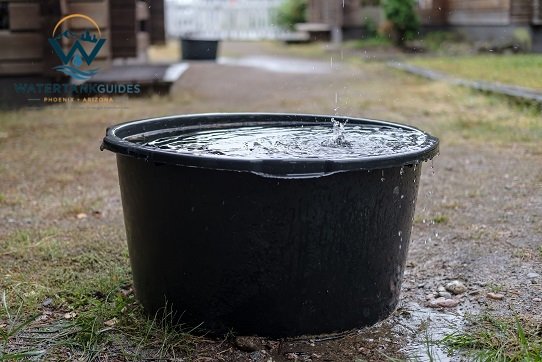
Its guidance defines a rain barrel as a container that stores rainfall for later use and discusses barrels connected to gutters or downspouts. It also recommends sealed lids to reduce debris, evaporation and mosquito problems.
That does not mean every possible Phoenix cistern installation is automatically exempt from building rules.
It does show that residential rainwater harvesting itself is an accepted water-conservation practice in Phoenix.
Is There a Limit on How Much Rainwater You Can Collect in Arizona?
Official University of Arizona guidance does not identify a statewide residential quantity cap for private rainwater harvesting.
Instead, the practical limits usually come from:
- How much roof area you have
- Local rainfall
- Tank capacity
- Available property space
- Installation requirements
- How much stored water you can actually use
For a normal homeowner collecting roof runoff on their own property, Arizona’s guidance focuses on system design and use rather than imposing a small statewide gallon limit.
However, a very large engineered project could create building, structural, drainage, plumbing or other regulatory questions even though collecting the rainfall itself remains legal.
How Much Rainwater Could a Phoenix Home Actually Collect?
This is where Arizona’s low annual rainfall can be misleading.
Phoenix does not receive much rain compared with many parts of the country, but a large roof can capture a surprising volume during monsoon and winter storms.
University of Arizona Cooperative Extension uses this formula:
Roof area × rainfall in inches × 0.623 × collection efficiency = gallons collected
It suggests approximately 90% efficiency for many roof catchments when estimating practical collection potential.
Older University of Arizona guidance puts average annual rainfall in Maricopa County at roughly 7–8 inches.
Phoenix example
Suppose a home has:
- 1,500 square feet of usable roof area
- 7.5 inches of annual rainfall
- 90% estimated collection efficiency
The calculation is:
1,500 × 7.5 × 0.623 × 0.90 ≈ 6,308 gallons per year
That does not mean you need a 6,300-gallon tank.
The rain arrives at different times throughout the year, the tank may be used between storms, and actual rainfall and collection losses vary.
But it illustrates why even Phoenix-area rooftops can provide meaningful water for landscaping.
Passive vs. Active Rainwater Harvesting
Arizona homeowners can harvest rain in two main ways.
Passive rainwater harvesting
Passive systems keep rain in the landscape rather than putting it into a tank.
Examples include:
- Basins
- Berms
- Swales
- Rain gardens
- Contoured landscapes
- Directing roof runoff toward trees
University of Arizona describes passive harvesting as modifying landscapes and hard surfaces so runoff is held, redirected or infiltrated where plants can use it.
Active rainwater harvesting
Active systems physically store water.
Typical components include:
- Roof or other catchment surface
- Gutters
- Downspouts
- Debris screen
- First-flush system where appropriate
- Rain barrel or cistern
- Overflow
- Outlet
- Optional pump
ADWR recognizes both simple residential systems and larger systems involving tanks, filters and pumps.
Both approaches are useful in Arizona, and many properties combine them: the tank captures part of a storm while overflow is routed into landscape basins.
Can You Drink Harvested Rainwater in Arizona?
This is where legality and safety must be separated.
Arizona allows rainwater harvesting, but water running across a roof should not automatically be treated as drinking water.
It can pick up:
- Dust
- Bird and animal waste
- Pollen
- Roofing particles
- Metals
- Microorganisms
- Other airborne contamination
Research involving rooftop-harvested rainwater in Arizona has found that contaminant levels can vary considerably by location, season and nearby environmental conditions.
University of Arizona guidance says that using collected rainwater for indoor purposes can require filtration and disinfection. Its guidance for potable rainwater systems recommends food-grade materials and regular water-quality testing.
The City of Phoenix has also historically advised residents not to drink untreated roof runoff, while promoting its capture for irrigation.
Non-potable use is much simpler
For most Phoenix homeowners, collected rainwater is most straightforward for:
- Landscape irrigation
- Trees
- Shrubs
- Native plants
- General outdoor water conservation
If you want to connect harvested rainwater to indoor plumbing or use it for drinking, cooking or bathing, that moves the project into a much more technical category.
Consult the applicable local building/plumbing authority and qualified professionals rather than relying on a basic rain-barrel guide.
Do You Need to Treat Rainwater for Garden Use?
Usually not to the same standard required for drinking water, but you should still design the system to limit contamination.
A good residential collection system should include appropriate measures such as:
- Gutter screening
- Debris removal
- A covered tank
- Mosquito-resistant screening
- Controlled overflow
- An opaque container
- Periodic inspection and cleaning
University of Arizona specifically recommends screening container openings to keep mosquitoes out and using opaque storage to limit algae growth.
Phoenix’s Green Infrastructure Handbook likewise recommends sealed rain-barrel lids to limit debris, evaporation and mosquitoes.
Can You Collect Rain From Any Surface?
Not every surface produces the same water quality.
For simple landscape irrigation, roof runoff is commonly used.
But if the water is intended for higher-contact or potable applications, the materials in the catchment system become much more important.
University of Arizona recommends carefully evaluating all materials that contact water intended for potable use, including the roof, gutters, pipes and tank.
Avoid assuming that water is clean simply because the rainfall itself began clean.
The catchment surface becomes part of the water system.
What About Overflow?
Overflow is one of the most important parts of an Arizona rainwater system—especially during intense monsoon storms.
Every tank eventually fills.
Once that happens, additional runoff needs somewhere safe to go.
University of Arizona guidance stresses that collection systems should be designed for storms that exceed storage capacity. For active systems, overflow should be routed away from the cistern and away from the home’s foundation.
A good overflow plan should avoid:
- Sending water toward your foundation
- Flooding a neighboring property
- Creating erosion
- Blocking existing drainage paths
- Creating standing mosquito habitat
This is one area where “I legally collected the rain” does not excuse poor drainage design.
Can an HOA Affect Your Rainwater Tank?
State legality does not automatically override every private community rule governing the appearance or placement of structures.
If you live in an HOA, review your current CC&Rs and architectural rules before installing a large visible cistern, especially in a front or side yard.
The important distinction is:
The State of Arizona permits rainwater harvesting, while an individual installation may still be subject to otherwise applicable property, architectural, zoning or building requirements.
Do not rely on internet claims that every Arizona HOA either can or cannot restrict a tank. Check the current governing documents and, for a dispute, obtain appropriate legal advice.
Does Rainwater Harvesting Affect Arizona Water Rights?
A normal rooftop rainwater system is not the same thing as obtaining an Arizona surface-water appropriation.
Arizona Revised Statutes §45-141 addresses water flowing in natural channels and other specified surface-water sources as public water subject to appropriation.
At the same time, Arizona’s own official resources expressly allow and promote harvesting rainfall on private property.
The practical boundary for a homeowner is straightforward:
Capturing rain off your roof is one thing. Diverting a natural stream or other regulated surface-water source is another.
Do not use a residential rainwater-harvesting guide as authority to dam, divert or appropriate water from a natural channel.
Does Arizona Encourage Rainwater Harvesting?
Yes.
This is one reason the idea that rainwater collection is generally “illegal in Arizona” is especially misleading.
The Arizona Department of Water Resources promotes rainwater harvesting as a conservation technique that can reduce potable-water use for landscaping.
Arizona law also specifically lists rainwater-harvesting programs and projects among eligible uses of the Water Conservation Grant Fund.
The state therefore does more than merely tolerate the practice—it recognizes rainwater harvesting as a water-conservation strategy.
That does not mean every homeowner automatically qualifies for a rebate or grant. Funding programs have their own eligibility rules and can change.
A Legal and Practical Checklist Before Installing a System
For a basic Arizona residential system, work through these questions.
1. Are you collecting rain that falls on your property?
For ordinary rooftop harvesting, that is the straightforward legal scenario recognized by University of Arizona guidance.
2. How large is the tank?
A small barrel and a multi-thousand-gallon cistern may trigger very different construction considerations.
3. Is the tank above or below ground?
Never bury an above-ground tank unless the manufacturer specifically rates it for underground installation.
Excavation and underground systems may create additional permitting, structural and utility concerns.
4. Will the system connect to household plumbing?
If yes, check local plumbing requirements and use qualified professionals where required.
5. Will anyone drink the collected water?
If yes, treat the project as a potable-water system rather than a simple landscaping barrel. Appropriate filtration, disinfection, materials and testing become essential.
6. Where will overflow go?
Design it before the first monsoon storm, not after the tank overflows.
7. Are there local or HOA requirements?
Check your city, town or Maricopa County jurisdiction as applicable and review private community rules before installing a large visible system.
Common Mistakes to Avoid
Do not:
- Assume rainwater harvesting is illegal because of another state’s rules
- Confuse rooftop runoff with diverting a natural stream
- Assume “legal to collect” means “safe to drink”
- Install a large cistern without checking applicable local requirements
- Connect untreated rainwater directly to drinking-water plumbing
- Leave tank openings unscreened
- Ignore mosquitoes
- Use a translucent tank that encourages algae growth
- Forget an overflow route
- Send overflow toward your home’s foundation
- Assume annual rainfall equals the tank capacity you need
Frequently Asked Questions
Is it illegal to collect rainwater in Arizona?
No. Arizona allows property owners to collect rainwater falling on their property. University of Arizona guidance specifically states that rainwater can legally be stored in rain barrels or cisterns for later use.
Do I need a permit to collect rainwater in Arizona?
Arizona does not have a statewide regulatory permit simply for a private rainwater-harvesting system. Local construction, plumbing, zoning or building requirements may apply depending on the size and design of your installation.
Is collecting rainwater legal in Phoenix?
Yes. Phoenix publishes residential guidance describing the use of rain barrels and rain-gutter systems to capture and store rainfall. Large or complex installations may still be subject to applicable city codes.
Is there a limit on rainwater collection in Arizona?
Official Arizona homeowner guidance does not identify a general statewide gallon limit for ordinary private rainwater harvesting. Large installations can still be affected by local building, zoning, structural or plumbing requirements.
Can I use Arizona rainwater for my garden?
Yes. Landscape irrigation is one of the primary uses promoted by the Arizona Department of Water Resources and University of Arizona Cooperative Extension.
Can I drink rainwater collected from my roof?
Do not drink untreated rooftop runoff simply because collecting it is legal. Roof runoff can contain microorganisms, dust and other contaminants. Potable systems require careful material selection, filtration/disinfection and regular testing, along with compliance with applicable local requirements.
Are rain barrels legal in Arizona?
Yes. Rain barrels are one of the standard collection methods described by Arizona water-conservation resources.
Can I collect monsoon rain in Phoenix?
Yes. Monsoon rainfall can be captured from your roof and stored, provided the system safely handles overflow and follows any applicable local rules.
Does Arizona encourage rainwater harvesting?
Yes. ADWR promotes it as a conservation method, and Arizona statutes identify rainwater-harvesting projects as eligible uses under the state’s Water Conservation Grant Fund.
Bottom Line
Rainwater harvesting is legal in Arizona.
For a typical Phoenix-area homeowner, collecting water from a roof into a barrel or cistern for landscape irrigation is a legitimate and state-supported conservation practice.
What changes with the project is not usually your basic right to catch the rain—it is the complexity of the installation.
A small outdoor barrel is relatively simple.
A large permanent cistern, underground tank, pressurized system, or installation connected to household plumbing may involve local building, structural, drainage, plumbing or water-quality requirements.
And if the water will be consumed, legal collection should never be confused with potable-water safety.
For most Arizona homes, the best starting point is simple: capture roof runoff, keep the tank covered, provide safe overflow, use the water for landscaping, and verify local requirements before turning a basic rain barrel into a major plumbing project.