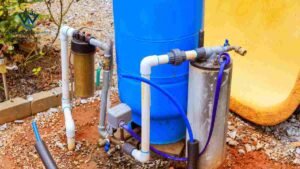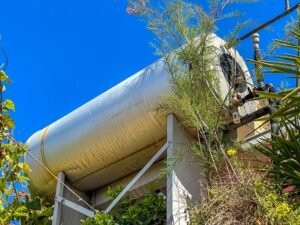
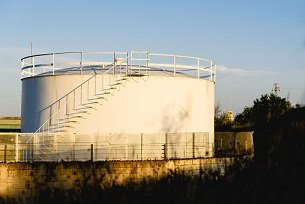
An above ground water tank is a water storage container installed at or above ground level, making it easier to inspect, clean, maintain, and connect to a home’s water system. These tanks are commonly used for residential water storage, rainwater harvesting, irrigation, emergency water supplies, and properties that rely on wells.
The right tank depends on how much water you need, what the water will be used for, the available installation space, and the tank material. A 500-gallon tank may be suitable for one application, while a 1,000-, 2,500-, or 5,000-gallon tank may make more sense for a larger household, irrigation system, or emergency supply.
What Is an Above Ground Water Tank?
An above ground water tank is a storage tank that sits on the ground or on a properly designed support structure rather than being buried underground.
The term can describe several types of tanks, including polyethylene, fiberglass, steel, stainless steel, and concrete storage tanks. Some are designed for potable water, while others are intended for rainwater, irrigation, agricultural use, or other non-potable applications.
For drinking water, the tank and water-contact components should be suitable for potable-water use. NSF notes that NSF/ANSI/CAN 61 covers drinking-water system components and health effects, and certified products should carry the applicable NSF marking or documentation.
An above ground design also makes the tank easier to access than a buried tank. You can generally inspect the exterior, fittings, connections, and surrounding area without excavation.
How Does an Above Ground Water Tank Work?
The basic system is straightforward:
Water source → inlet → storage tank → outlet → pump or gravity flow → point of use
The water source might be:
- Municipal water
- A private well
- Rainwater harvesting
- A delivered water supply
- A treatment or filtration system
From the tank, water can flow by gravity if the elevation and system design provide enough pressure. Otherwise, a pump may be required.
For larger or more technical systems, tank capacity and associated pumping equipment need to be matched to actual water demand. EPA guidance emphasizes that storage capacity should be adequate for the system’s water demands and appropriate to applicable standards and engineering practice.
Types of Above Ground Water Tanks
Not every above ground water tank serves the same purpose. The material, shape, capacity, and plumbing connections should match the intended use.
Polyethylene Water Tanks
Polyethylene, often called poly, is widely used for residential water storage because it is relatively lightweight and available in many shapes and capacities.
These tanks can be useful for:
- Rainwater harvesting
- Potable water storage when properly certified
- Irrigation
- Emergency water storage
- Well-water storage
NSF’s current listings include polyethylene water storage tanks and potable-water tank products in a wide range of capacities, showing that certified polyethylene tanks are available for water-contact applications.
Steel Water Tanks
Steel tanks are commonly used for larger storage requirements and some commercial, agricultural, and municipal applications.
They can provide substantial structural strength, but corrosion protection and coating conditions become important maintenance considerations.
Steel is particularly common in larger ground-level and elevated storage systems. EPA guidance identifies steel and concrete among materials used for ground-level water storage.
Stainless Steel Tanks
Stainless steel can be selected where corrosion resistance, durability, and a clean appearance are important.
However, stainless steel usually costs more than basic polyethylene, so the higher material cost needs to be justified by the application.
Fiberglass Tanks
Fiberglass-reinforced tanks can offer a combination of corrosion resistance and structural strength. They are used in various water-storage and treatment applications.
The exact suitability depends on the tank’s construction, water chemistry, installation conditions, and manufacturer’s specifications.
Concrete Tanks
Concrete is generally associated with larger, permanent water-storage installations.
It can be extremely durable when correctly designed and constructed, but it is much less convenient to move than a polyethylene tank and usually requires more substantial site preparation.
Best Materials for Above Ground Water Tanks
There is no single material that is best for every application.
| Tank Material | Common Uses | Main Consideration |
| Polyethylene | Homes, rainwater, irrigation | Lightweight and versatile |
| Steel | Large storage, agriculture, commercial | Corrosion protection |
| Stainless steel | Specialized residential/commercial use | Higher material cost |
| Fiberglass | Water treatment and storage | Construction and site suitability |
| Concrete | Permanent large storage | Heavy and difficult to relocate |
The most important question is not simply which material costs less. Ask whether the tank is designed for the type of water being stored, the intended installation method, the local climate, and the required service life.
Common Above Ground Water Tank Sizes
Above ground water tanks are available in many capacities.
Common residential and small-property sizes include:
- 250 gallons
- 500 gallons
- 1,000 gallons
- 1,500 gallons
- 2,500 gallons
- 5,000 gallons
Larger tanks can go well beyond 5,000 gallons.
Current NSF listings, for example, include certified polyethylene tank products ranging from small tanks to vertical water tanks listed up to 20,000 gallons. That does not mean every size is appropriate for a home; the correct capacity depends on the application and site.
500-Gallon Tank
A 500-gallon tank can be useful when space is limited or when the goal is short-term storage rather than a large emergency reserve.
1,000-Gallon Tank
A 1,000-gallon water tank provides substantially more storage while remaining practical for many residential and agricultural applications.
2,500-Gallon Tank
A 2,500-gallon tank may be appropriate for larger water-storage requirements, including some irrigation, rainwater harvesting, and emergency-storage applications.
5,000-Gallon Tank
A 5,000-gallon tank is a major storage system and requires careful attention to the foundation, tank dimensions, plumbing, access, overflow, and site drainage.
The tank should not be selected based only on the gallon number. A full 5,000-gallon tank contains more than 41,700 pounds of water, before adding the weight of the tank itself.
How to Choose the Right Tank Size
Start with your actual water requirement.
A simple planning formula is:
Required storage = daily water demand × desired storage days
For example, if a property needs an estimated 100 gallons per day and you want three days of storage:
100 × 3 = 300 gallons
That does not automatically mean you should buy a 300-gallon tank. You may need additional capacity for operational limits, unusable volume, irrigation demand, seasonal changes, or emergency planning.
For a more complete estimate, consider:
- Number of people
- Daily indoor water use
- Irrigation requirements
- Well production rate
- Municipal supply reliability
- Rainfall patterns
- Emergency-storage goals
- Available tank space
- Pump capacity
- Local regulations
For water-volume calculations, you can also use the Water Tank Volume Calculator to estimate capacity from tank dimensions.
Above Ground vs. Underground Water Tanks
Both installation types have advantages.
| Feature | Above Ground | Underground |
| Inspection | Easier | More difficult |
| Cleaning access | Usually easier | More limited |
| Installation | Less excavation | Requires excavation |
| Space use | Takes surface space | Saves surface space |
| Leak detection | Easier to identify | Can be difficult |
| Relocation | Possible for some tanks | Usually impractical |
| Maintenance access | Convenient | More difficult |
An above ground water tank is often attractive when easy access and simple maintenance are priorities.
An underground tank can be useful when preserving yard space or reducing the visible appearance of a large tank is more important.
How to Install an Above Ground Water Tank
A safe installation starts with the foundation.
1. Choose a Suitable Location
The site should provide enough room for the tank, plumbing, maintenance access, and overflow.
Avoid placing the tank where drainage problems could undermine its foundation.
2. Prepare a Stable Base
The base needs to support the full weight of the filled tank.
For example, 1,000 gallons of water weighs approximately 8,340 pounds. A 5,000-gallon tank holds more than 41,700 pounds of water.
The manufacturer’s installation requirements should determine the foundation design.
3. Connect the Inlet and Outlet
Use properly sized plumbing and fittings suitable for the tank and intended water use.
The system may also need:
- Shutoff valves
- Overflow piping
- Drain connection
- Pump
- Filter
- Pressure controls
- Level indicator
4. Install Overflow Protection
A tank needs a controlled way to handle excess water.
EPA storage-tank guidance identifies overflow arrangements, vents, access hatches, and properly located inlet/outlet piping as important components in water-storage systems.
5. Test the System
Before putting the system into regular operation, check the tank, fittings, valves, foundation, inlet, outlet, overflow, and pump for leaks or other problems.
Where Should You Place an Above Ground Water Tank?
Placement can affect the tank’s life and maintenance requirements.
A good location should have:
- Stable ground
- Proper drainage
- Adequate access
- Enough clearance for inspection
- Protection from vehicle impact
- Suitable distance from contamination sources
- Space for plumbing and overflow
- Access for cleaning or replacement
Direct sunlight can also increase heat exposure, particularly in hot climates.
In very hot areas, consider whether the tank’s material, color, location, and any manufacturer-approved protection are suitable for the environment.
Avoid assuming that placing any tank under a homemade cover or enclosure is automatically safe. Ventilation, access, structural loading, and manufacturer requirements still matter.
Above Ground Water Tank Maintenance
Regular maintenance helps identify problems before they become expensive.
Inspect the tank periodically for:
- Cracks
- Bulging or deformation
- Corrosion
- Leaking fittings
- Damaged valves
- Blocked vents
- Contaminated access points
- Sediment
- Algae growth where applicable
For potable-water storage, also pay attention to the tank’s lid, access hatch, vent, and plumbing connections.
EPA guidance for treated-water storage identifies features such as protected access, screened vents, water-level measurement, overflow arrangements, and inlet/outlet placement as important storage-tank considerations.
For general cleaning guidance, see our guide to cleaning a water tank at home.
How Long Does an Above Ground Tank Last?
Tank life depends on material, water chemistry, UV exposure, installation quality, maintenance, and operating conditions.
There is no single lifespan that applies to every above ground water tank.
EPA materials also note that useful life can vary with maintenance, water quality, use, and soil conditions.
Instead of relying on a generic number of years, inspect the actual tank and follow the manufacturer’s maintenance and replacement recommendations.
Common Problems to Watch For
Tank Leaks
A leak may come from the tank body, outlet fitting, valve, gasket, or connected plumbing.
Small leaks should not be ignored because a full tank can place significant load on the surrounding area.
Foundation Movement
An uneven or unstable foundation can cause stress on the tank.
This is particularly important for large tanks because water becomes extremely heavy as capacity increases.
Algae Growth
Light exposure can contribute to algae growth in some water-storage systems.
Choosing an appropriate tank, limiting unwanted light exposure, keeping the tank covered, and maintaining water quality can help.
Poor Water Turnover
If stored water remains in a tank for extended periods, water quality can become a concern.
Storage should be designed around actual usage rather than simply maximizing tank size.
Frozen Pipes
In cold climates, exposed pipes and fittings may freeze even when the tank itself remains intact.
Insulation and freeze protection should follow local conditions and the manufacturer’s recommendations.
Above Ground Water Tank Cost Factors
The price of an above ground water tank depends on much more than its gallon capacity.
Important cost factors include:
- Tank material
- Tank capacity
- Tank shape
- Potable-water certification
- Foundation requirements
- Plumbing
- Pump equipment
- Filtration
- Delivery
- Crane or lifting requirements for large tanks
- Site preparation
- Local installation requirements
A 1,000-gallon polyethylene tank and a 1,000-gallon stainless-steel tank can have very different prices because the materials and construction are different.
For this reason, compare the complete installed system, not just the tank’s advertised price.
FAQs About Above Ground Water Tanks
What is the best material for an above ground water tank?
The best material depends on the intended use, capacity, climate, water chemistry, budget, and required durability. Polyethylene is common for residential applications, while steel, stainless steel, fiberglass, and concrete may suit different requirements.
How big should an above ground water tank be?
Tank size should be based on daily water demand, desired storage duration, water source, irrigation needs, available space, and emergency requirements. A simple starting point is daily demand multiplied by the number of storage days.
Can an above ground water tank be used for drinking water?
Yes, but the tank must be specifically suitable for potable-water storage. Look for appropriate certification and documentation for the tank and water-contact components. NSF/ANSI/CAN 61 is an important standard covering health effects for drinking-water system components.
Does an above ground water tank need a foundation?
Large tanks need a properly prepared base capable of supporting the weight of the full tank and resisting movement. Follow the tank manufacturer’s installation requirements rather than assuming ordinary soil or a simple gravel area is sufficient.
Can I use an above ground tank for rainwater harvesting?
Yes. Above ground tanks are commonly used to collect and store rainwater for approved non-potable applications. The collection surface, first-flush arrangement, tank material, filtration, overflow, and intended end use should all be considered.
How often should an above ground water tank be cleaned?
The appropriate cleaning interval depends on the water source, tank design, sediment accumulation, and intended use. Instead of using one fixed schedule for every tank, inspect the tank and follow the manufacturer’s and applicable water-quality guidance.
Final Takeaway
An above ground water tank can provide a practical way to store water for residential use, rainwater harvesting, irrigation, wells, or emergency preparedness.
The best tank is not necessarily the biggest or cheapest. Start with the intended use, calculate the approximate storage requirement, select a suitable material, prepare a stable foundation, install proper plumbing and overflow protection, and plan for regular inspection and cleaning.
For potable water, make sure the tank and relevant water-contact components are approved or certified for that use. For larger installations, local requirements and professional engineering may also need to be considered.
The goal is simple: choose enough storage for your real water needs while making the system safe, accessible, maintainable, and suitable for its environment.